
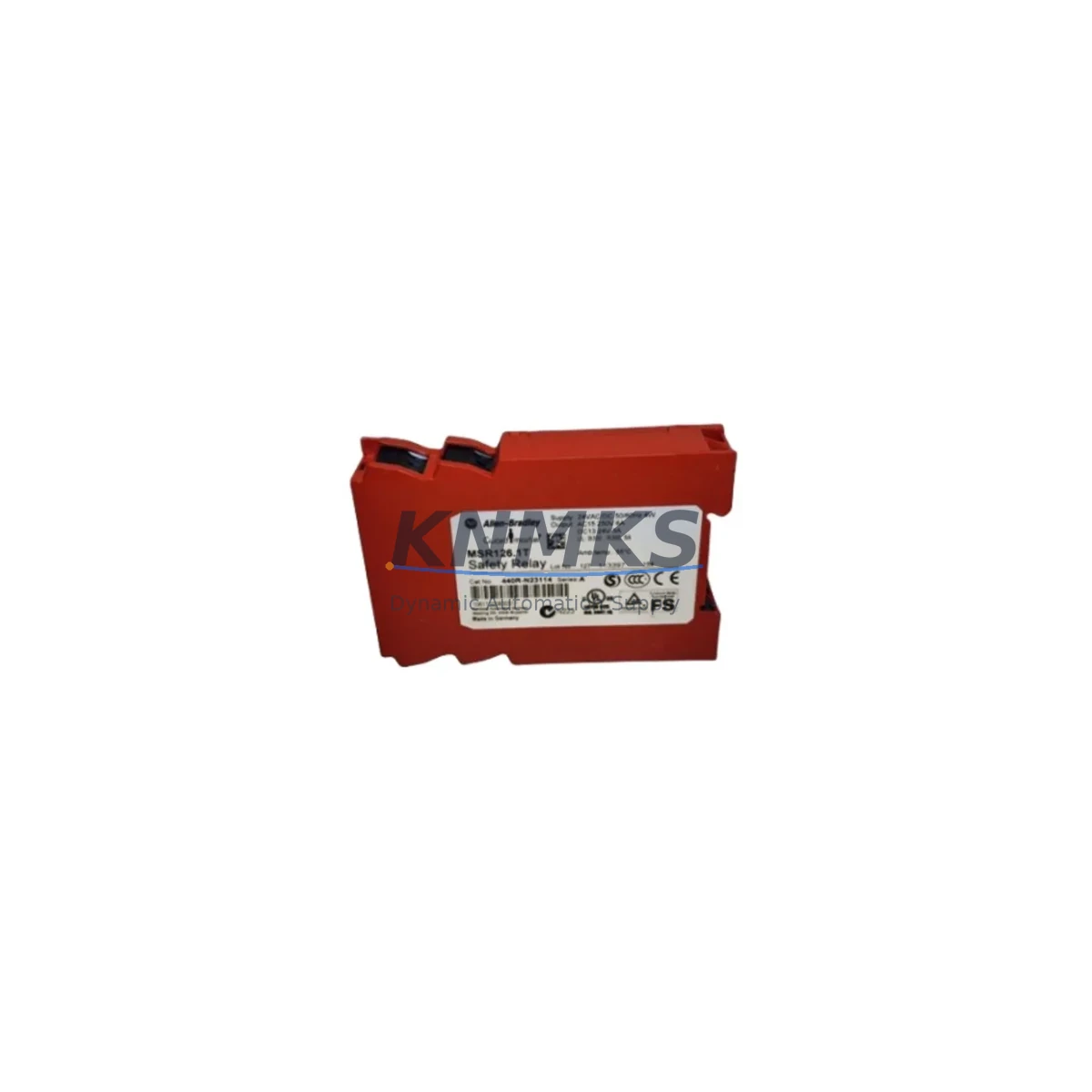
Overview
Allen-Bradley 440C-CR30-22BBB Migration-Ready Safety Relay for Legacy Control Systems
The Allen-Bradley 440C-CR30-22BBB is a Guardmaster CR30 configurable safety relay designed to serve as a direct migration solution for aging safety control architectures. Whether you are replacing an end-of-life safety module in a legacy control cabinet, upgrading a discontinued safety relay from an earlier Guardmaster generation, or retrofitting a machine safety circuit to meet current IEC 62061 or ISO 13849 standards, the 440C-CR30-22BBB provides a reliable, field-proven upgrade path with minimal disruption to existing wiring and program logic.
This unit supports up to 22 safety inputs and dual-channel output configurations, making it suitable for E-stop circuits, light curtain monitoring, two-hand control, safety gate interlock, and muting applications. Its configurable logic eliminates the need for multiple discrete safety relays in a single cabinet, reducing panel space requirements and simplifying the overall safety architecture during a retrofit project.
Before committing to a replacement, engineers should verify the following during retrofit planning: available 24 VDC supply capacity in the existing control cabinet, terminal block pitch compatibility with existing field wiring, DIN rail mounting space (the CR30 requires approximately 45 mm width), safety output current ratings relative to the downstream contactors or drives being controlled, and whether the existing PLC — such as a MicroLogix 1100 or CompactLogix L3x — has sufficient I/O capacity to receive the CR30 status outputs via hardwired or EtherNet/IP connections.
For installations where the legacy system used a 440R-series safety relay (such as the 440R-N23132 or 440R-D22R2) or an older MSR series module, the 440C-CR30-22BBB offers a functionally equivalent replacement with expanded configurability. The CR30’s onboard USB programming port and RSNetWorx or Studio 5000 Logix Designer integration allow safety logic to be documented, version-controlled, and validated without requiring a separate safety PLC. This is particularly valuable in retrofit scenarios where the original safety circuit was hardwired and undocumented.
When planning the migration, it is also important to account for the communication link between the CR30 and any upstream controller. If the existing system uses DeviceNet for safety I/O, a transition to EtherNet/IP safety — supported by the 440C-CR30-22BBB with the appropriate network option card — may require updates to the PLC program, network topology, and HMI alarm pages. Coordinating these changes in advance significantly reduces unplanned downtime during cutover. In multi-zone safety systems, the CR30 can be cascaded with other Guardmaster modules, including the 440C-CR30-9AO2 or safety I/O modules from the 1791DS series, to maintain zone-level safety integrity without replacing the entire safety architecture.
For cabinet integrators managing a phased retrofit, the 440C-CR30-22BBB can be pre-wired and pre-tested on a bench using the same terminal assignments as the legacy module, then swapped in during a planned maintenance window. This approach, combined with pre-shipment functional testing performed before dispatch, allows the replacement unit to be validated against the original safety function before it reaches the production floor.
Migration Compatibility Table
| Parameter | Details |
|---|---|
| SKU / Part Number | 440C-CR30-22BBB |
| Brand / Series | Allen-Bradley / Guardmaster CR30 |
| Safety Inputs | Up to 22 configurable safety inputs |
| Safety Outputs | Dual-channel relay outputs (2NO + 1NC) |
| Supply Voltage | 24 VDC (verify existing PSU capacity before installation) |
| Mounting | DIN rail, approx. 45 mm width required |
| Communication | USB (programming); optional EtherNet/IP safety network card |
| Common Legacy Replacements | 440R-N23132, 440R-D22R2, MSR series safety relays |
| Programming Tool | Studio 5000 Logix Designer / RSNetWorx |
| Safety Standard | IEC 62061 SIL 3 / ISO 13849 PLe Cat. 4 |
| Pre-Shipment Testing | Yes — functional safety output verification before dispatch |
| Support terms | support terms confirmed by quotation included |
| Retrofit Recommendation | Verify terminal pitch, PSU capacity, DIN rail space, and PLC I/O mapping before cutover |
| Commissioning Notes | Validate safety function via force-guided contact verification and PLC status bit confirmation after installation |
Retrofit Planning for Existing Automation Systems
A successful retrofit using the 440C-CR30-22BBB typically involves coordinating several interdependent components within the existing control architecture. In most legacy installations, the safety relay interfaces directly with the machine’s E-stop chain, gate interlock switches, and the main contactor or drive enable circuit. During the replacement process, engineers should map each existing terminal connection to the CR30’s input/output assignments before disconnecting the legacy module.
Power supply compatibility is a common first checkpoint. Many older control cabinets use a 24 VDC rail shared between the safety relay, PLC I/O modules, and HMI panel. Adding the CR30 to this rail requires confirming that the existing power supply — such as a 1606-XLP or Puls CP10 series unit — has sufficient residual capacity. If the cabinet also houses a 1769-IQ16 or 1769-OB16 CompactLogix I/O module for status feedback, the total current draw must be recalculated after the retrofit.
Terminal wiring is the next critical step. The CR30 uses a removable terminal block design, which allows pre-wiring of the replacement unit before the cutover window begins. Field wiring from safety devices — including Trojan T15 safety switches, Sick M4000 light curtains, or Pilz PNOZ safety gate monitors — can be transferred directly if the cable lengths and conductor cross-sections are compatible with the CR30’s terminal specifications.
For systems where the safety relay communicates status to a CompactLogix or ControlLogix PLC via hardwired inputs, the existing PLC program logic typically requires no modification beyond remapping the input addresses if the terminal assignments change. However, if the retrofit also involves migrating from a hardwired safety circuit to an EtherNet/IP safety network, the PLC program, safety task configuration, and HMI alarm pages will all require updates. In these cases, coordinating the firmware version of the CR30 with the Studio 5000 project version is essential to avoid compatibility issues during commissioning.
Signal isolators — such as the 1492-IFM series interface modules — may be required if the existing field wiring uses non-standard voltage levels or if the CR30 inputs need to be isolated from high-voltage field devices. Similarly, if the retrofit involves expanding the safety zone coverage, additional 1791DS safety I/O modules can be networked to the CR30 to extend the input count without replacing the central safety relay.
Downtime Control During System Migration
Minimizing unplanned downtime is the primary operational concern during any safety relay replacement. For the 440C-CR30-22BBB, the recommended approach is a parallel preparation strategy: the replacement unit is fully configured, wired on a sub-panel, and functionally tested before the production line is taken offline. This pre-commissioning step — which is part of the pre-shipment testing protocol for units supplied by KNMKS — ensures that the unit arriving on site has already been verified against the target safety function.
During the cutover window, the sequence should follow a defined procedure: isolate the machine from energy sources per LOTO requirements, document the existing terminal wiring with photographs before disconnection, remove the legacy safety relay, install the CR30 on the DIN rail, transfer field wiring using the pre-mapped terminal schedule, restore power, and perform a full safety function test before releasing the machine to production. This structured approach typically allows a single-relay replacement to be completed within a two- to four-hour maintenance window, depending on the complexity of the existing wiring.
Protecting the original PLC program logic is equally important. If the retrofit does not require changes to the PLC program, the existing ladder logic or function block diagram should be backed up before the cutover begins. If the safety relay replacement is part of a broader system upgrade — for example, migrating from a MicroLogix 1400 to a CompactLogix 5380 — the program conversion should be completed and validated in a simulation environment before the physical cutover. This prevents the safety relay replacement from being delayed by unresolved program compatibility issues.
For multi-zone safety systems, a phased replacement approach — replacing one safety zone at a time while keeping adjacent zones operational — can further reduce the impact on production schedules. The CR30’s zone-level output configuration supports this approach by allowing individual safety functions to be enabled or bypassed during commissioning without affecting the rest of the safety architecture.
Retrofit Support FAQ
Q: Is the 440C-CR30-22BBB a direct replacement for the 440R-N23132?
A: The 440C-CR30-22BBB is functionally compatible with the safety functions previously handled by 440R-series relays, but it is not a pin-for-pin drop-in replacement. Terminal assignments and DIN rail footprint differ. A wiring adapter schedule should be prepared before installation. The CR30 offers expanded configurability and higher input count compared to the 440R-N23132, which may allow consolidation of multiple legacy relays into a single unit.
Q: What commissioning steps are required after installation?
A: After physical installation and wiring, the CR30 safety logic must be downloaded via USB using Studio 5000 Logix Designer. A full safety function test — including E-stop actuation, gate interlock cycling, and output contactor drop-out verification — must be performed and documented before the machine is returned to service. PLC status bit mapping should also be verified to confirm that the upstream controller correctly receives the CR30 ready and fault outputs.
Q: Does KNMKS provide pre-shipment testing for this unit?
A: Yes. All 440C-CR30-22BBB units supplied by KNMKS undergo functional pre-shipment testing before dispatch. This includes power-on verification, safety output actuation testing, and basic input channel confirmation. A support terms confirmed by quotation is included with every unit, covering manufacturing defects and functional failures under normal operating conditions.
Q: What is the typical lead time and stock availability?
A: KNMKS maintains inventory of the 440C-CR30-22BBB to support urgent replacement and planned retrofit projects. Contact the sales team at admin@knmks.com or +86 18359268345 to confirm current stock levels and lead time for your specific quantity requirement. For long-term spare parts agreements covering 12 to 36 months of supply, volume pricing and reserved inventory arrangements are available.
© 2026 KNMKS. All rights reserved.
Original Source: https://knmks.com
Contact: admin@knmks.com | +86 18359268345
Product Identification
- Brand / Ecosystem
-
Allen-Bradley
Allen-Bradley - Model / Series
- 440C-CR30-22BBB
- Product Family
- Relays & Interface
- Availability Status
- Available on request after model and quantity confirmation
- Inquiry Type
- B2B RFQ, replacement inquiry and project spare-part request
- Pre-Quote Check
- Exact SKU, brand, series, quantity, nameplate photos and destination country are checked before quotation
System Path
Where this product fits in the KNMKS automation structure.
Specification & Inquiry Focus
- Interface range
- Relays, isolation and signal modules
- Common needs
- Coil voltage and contact rating
- Project support
- Panel wiring and signal protection
Buyer Confirmation
Information KNMKS checks before replying.
- Exact model
- 440C-CR30-22BBB
- Brand / ecosystem
- Allen-Bradley
- Product family
- Relays & Interface
- Application note
- Replacement, maintenance, project build or spare-part list
- Useful photos
- Nameplate, installed unit, cabinet layout or connector side
- Delivery details
- Quantity, destination country and target schedule
Document Support
Files and notes can be confirmed during quotation.
- Product photos or nameplate confirmation when available
- Packing and delivery notes before quotation confirmation
- Support scope and delivery terms confirmed per inquiry
- Export document coordination for qualified B2B requests
Inquiry Support
- Relay base and module matching
- Signal isolation and protection options
- Panel accessory inquiry support
What to Send Us
- Brand and exact model number: Allen-Bradley 440C-CR30-22BBB
- Quantity and required delivery time
- Application, replacement requirement or nameplate photo
- Destination country and shipping preference
RFQ Preparation
This is a product inquiry page built for RFQ communication.
Fast Model Check
Send this model to KNMKS for confirmation.
Include quantity, destination country and photos if this is a maintenance replacement. The inquiry will be saved with a reference number after submission.
Brand & Compatibility Note
KNMKS displays automation product information for well-known industrial brand ecosystems and compatible replacement references. Brand names are used for product identification and compatibility reference only; final availability and commercial terms are confirmed per quotation.
 Manufacturing
 Machine Tools
 Packaging
 Energy & Power
 PLCs & Controllers
 HMI & Displays
 Servo Systems
 Variable Frequency Drives