
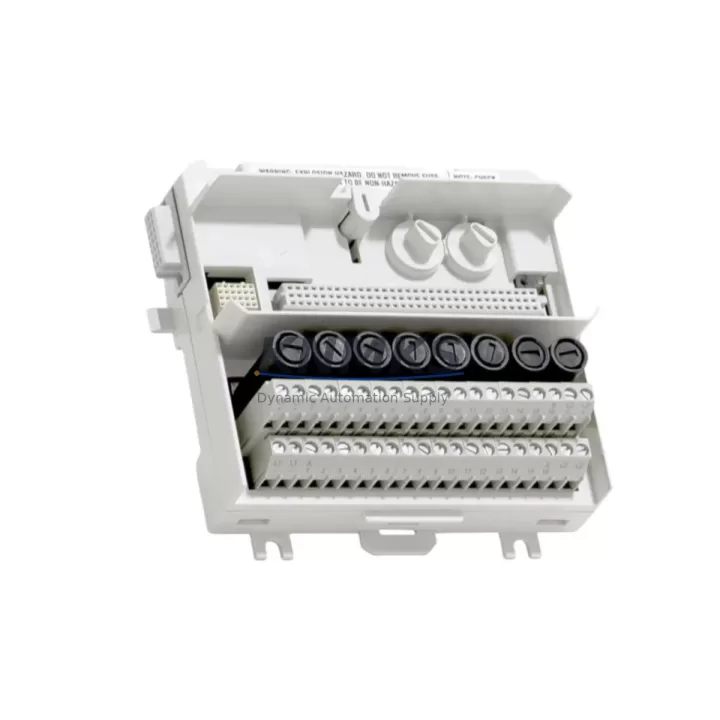
Overview
ABB TU838 Migration-Ready Terminal Unit for Legacy DCS Systems
The ABB TU838 is a field-proven terminal unit engineered for the S800 I/O platform, widely deployed across DCS-controlled processes in energy, petrochemical, pulp & paper, and continuous manufacturing environments. As legacy control architectures approach end-of-life and OEM support windows close, the TU838 remains one of the most reliable drop-in solutions for engineers managing phased migrations, emergency spare replacements, and control cabinet upgrades without full system overhauls.
When replacing a failed or discontinued terminal unit in an existing S800 rack, the TU838 preserves the original field wiring termination layout, eliminating the need to re-label or re-route signal cables. This is critical in brownfield installations where documentation may be incomplete or where minimizing downtime is the primary constraint. The module slots directly into the S800 backplane, maintaining the same I/O addressing scheme used by the predecessor unit — provided the DCS controller configuration and module type assignment remain consistent.
Before installation, engineers should verify the power supply capacity of the existing rack. The TU838 draws from the S800 bus power rail, and in densely populated cabinets — particularly those running a mix of AI810, AO810, DI810, and DO810 I/O modules alongside communication interfaces — the aggregate current draw must be recalculated to confirm headroom. If the existing TB820 or TB840 power supply module is operating near its rated output, a parallel power feed or module redistribution may be required prior to inserting the replacement unit.
Terminal block wiring should be inspected and torqued to specification during the replacement window. Field signal cables connected to the TU838 carry analog and digital process values directly into the I/O module stack, and loose terminations are a common source of intermittent faults that are difficult to diagnose post-commissioning. Where the original installation used spring-clamp terminals, confirm that the TU838 variant on hand matches the terminal style of the existing assembly to avoid adapter requirements.
Migration Compatibility Table
| Parameter | Detail |
|---|---|
| Compatible Platform | ABB S800 I/O (AC800M / AC800F / Freelance 800F DCS) |
| Backplane Interface | S800 ModuleBus — direct slot replacement, no mechanical modification |
| Terminal Style | Screw-clamp field wiring terminals (confirm variant before ordering) |
| Power Source | S800 bus rail — verify TB820 / TB840 capacity before installation |
| I/O Module Compatibility | AI810, AO810, DI810, DO810, AI820, AO820 series |
| Communication Protocol | ModuleBus (optical or electrical per rack configuration) |
| DCS Controller Compatibility | AC800M, AC800F, Freelance 800F |
| Addressing | Module address preserved from original slot position — no re-addressing required |
| Firmware Dependency | No firmware on TU838 — firmware resides on paired I/O module |
| Installation Space | Standard S800 rack slot — no panel modification required |
| Replacement Scope | Drop-in for TU830, TU831, TU835, TU836, TU837 (verify I/O module pairing) |
| Commissioning Requirement | DCS controller re-download not required if slot address and module type unchanged |
| Pre-Shipment Testing | Function-tested and visually inspected before dispatch |
| Support terms | 12 months from shipment date — covers manufacturing defects |
Retrofit Planning for Existing Automation Systems
A successful TU838 retrofit begins well before the physical replacement. In most S800-based DCS installations, the terminal unit is paired with a specific I/O module type — for example, an AI810 analog input module or a DI810 digital input module mounted on a TU830 or TU838 terminal unit. When sourcing a replacement, the pairing must be confirmed against the original hardware configuration in the DCS engineering station. Mismatched pairings will result in a hardware fault alarm and the I/O channel will not be recognized by the controller.
In systems where the S800 rack communicates via an optical ModuleBus segment, the TB820 or TB840 communication interface module at the head of the rack must be operational and correctly addressed. If the rack has experienced a partial failure affecting multiple slots, it is advisable to also inspect the CI854 or CI858 communication interface at the AC800M controller end to rule out upstream faults before attributing the problem to the terminal unit alone. These communication modules are common failure points in aging installations and should be included in the spare parts inventory alongside the TU838.
For installations running Freelance 800F with AC800F controllers, the S800 I/O architecture is identical in hardware but the engineering tool is Freelance Engineering instead of Control Builder M. Spare management and module replacement procedures follow the same physical steps, but the diagnostic workflow differs — faults are viewed in the Freelance Diagnostic Viewer rather than the AC800M hardware tree.
Cabinet-level planning should account for the physical dimensions of the S800 rack and the available DIN rail or panel space. In retrofit projects where the original rack is being partially replaced or expanded, additional S800 remote I/O stations may be introduced to extend the I/O count without replacing the controller. In these cases, the TU838 units in the new rack sections must be addressed sequentially and the DCS project updated to reflect the expanded hardware topology before the new I/O is brought online. Signal isolators or galvanic separation barriers may also need to be inserted in the field wiring path where older installations share common ground references with control power, to maintain measurement integrity after the replacement.
Downtime Control During System Migration
Minimizing process downtime during a TU838 replacement requires a structured pre-outage preparation sequence. Before the maintenance window opens, the DCS operator should place the affected I/O channels in manual mode or transfer control to redundant measurement points where available. This prevents the controller from generating spurious alarms or initiating automatic shutdowns based on the loss of signal during the physical swap.
The original program logic in the AC800M or AC800F controller does not need to be modified for a like-for-like TU838 replacement. The I/O module mounted on the terminal unit retains its configuration in the DCS project, and as long as the slot address and module type are unchanged, the controller will recognize the replacement hardware automatically upon power restoration. This eliminates the need for a full project download and significantly reduces commissioning time in the field.
Field wiring should be photographed and documented before disconnection, even in installations with up-to-date as-built drawings. Terminal numbering on the TU838 follows the S800 standard, but field cable labeling in older plants may not match the current documentation. A pre-removal photo record provides a reliable reference during reconnection and reduces the risk of wiring errors that could damage the new module or connected field instruments.
After the TU838 is installed and field wiring is reconnected, the I/O channels should be verified individually before returning the loop to automatic control. This includes confirming signal range, checking for open-circuit or short-circuit faults, and verifying that the DCS faceplate values match the field instrument readings. For analog output channels connected via an AO810 or AO820 module, a manual output test should be performed to confirm that the field actuator responds correctly before the loop is handed back to the control system.
Where the replacement is part of a larger migration from an older DCS platform — such as a transition from a Bailey INFI 90 or Honeywell TDC 3000 architecture to an ABB AC800M-based system — the TU838 and its associated I/O modules form the field interface layer of the new architecture. In these projects, the migration is typically executed in phases, with individual control loops migrated one at a time to minimize the scope of each outage and allow the operations team to validate each loop before proceeding to the next.
Retrofit Support FAQ
Q: Can the TU838 replace a TU830 or TU835 directly?
A: In most cases, yes — the TU838 is mechanically and electrically compatible with the S800 backplane and accepts the same I/O module types. However, the specific I/O module pairing must be verified against the DCS hardware configuration. Some TU8xx variants have different terminal layouts or are designed for specific module types. Confirm the part number pairing in the ABB S800 I/O hardware documentation before ordering.
Q: Does replacing the TU838 require a DCS controller download?
A: No, provided the replacement is like-for-like and the slot address is unchanged. The AC800M or AC800F controller will recognize the hardware automatically upon power-up. A full project download is only required if the I/O module type or slot address changes as part of the replacement.
Q: What pre-shipment testing is performed on the TU838?
A: Each unit is function-tested and visually inspected before dispatch. Testing confirms backplane connector integrity, terminal block condition, and basic electrical continuity. Units are shipped with a support terms confirmed by quotation covering manufacturing defects from the shipment date.
Q: Is stock available for immediate shipment?
A: Yes. The TU838 is maintained in inventory for prompt dispatch. Lead times and current stock levels can be confirmed by contacting the sales team directly. For urgent replacement requirements, expedited shipping options are available to minimize process downtime.
© 2026 KNMKS. All rights reserved.
Original Source: https://knmks.com
Contact: admin@knmks.com | +86 18359268345
Product Identification
- Brand / Ecosystem
-
ABB
ABB - Model / Series
-
TU838
AC800M Series - Product Family
- PLCs & Controllers
- Availability Status
- Available on request after model and quantity confirmation
- Inquiry Type
- B2B RFQ, replacement inquiry and project spare-part request
- Pre-Quote Check
- Exact SKU, brand, series, quantity, nameplate photos and destination country are checked before quotation
System Path
Where this product fits in the KNMKS automation structure.
Specification & Inquiry Focus
- Control platform
- PLC, PAC and modular controllers
- Common needs
- CPU, rack, power and I/O expansion
- Project support
- Replacement, cabinet build and maintenance
Buyer Confirmation
Information KNMKS checks before replying.
- Exact model
- TU838
- Brand / ecosystem
- ABB
- Product family
- PLCs & Controllers
- Application note
- Replacement, maintenance, project build or spare-part list
- Useful photos
- Nameplate, installed unit, cabinet layout or connector side
- Delivery details
- Quantity, destination country and target schedule
Document Support
Files and notes can be confirmed during quotation.
- Product photos or nameplate confirmation when available
- Packing and delivery notes before quotation confirmation
- Support scope and delivery terms confirmed per inquiry
- Export document coordination for qualified B2B requests
Inquiry Support
- Model cross-checking before quotation
- CPU, power, rack and expansion module matching
- Support for replacement and project inquiry
What to Send Us
- Brand and exact model number: ABB TU838
- Quantity and required delivery time
- Application, replacement requirement or nameplate photo
- Destination country and shipping preference
RFQ Preparation
This is a product inquiry page built for RFQ communication.
Fast Model Check
Send this model to KNMKS for confirmation.
Include quantity, destination country and photos if this is a maintenance replacement. The inquiry will be saved with a reference number after submission.
Brand & Compatibility Note
KNMKS displays automation product information for well-known industrial brand ecosystems and compatible replacement references. Brand names are used for product identification and compatibility reference only; final availability and commercial terms are confirmed per quotation.
 Manufacturing
 Machine Tools
 Packaging
 Energy & Power
 HMI & Displays
 Servo Systems
 Variable Frequency Drives
 Sensors