
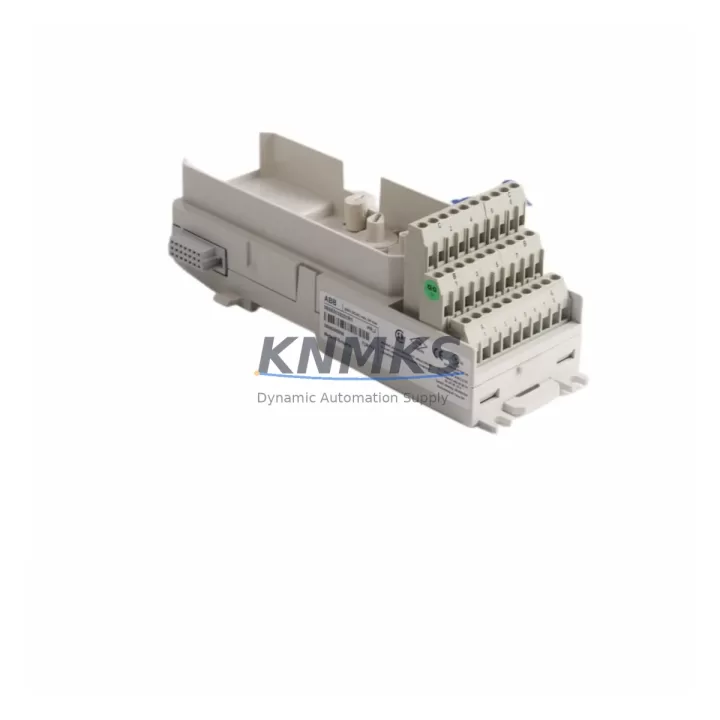
Overview
ABB TU811V1 3BSE013231R1 Migration-Ready I/O Termination Unit: Legacy System Retrofit & Compatibility Upgrade
The ABB TU811V1 (catalog number 3BSE013231R1) is a field-proven S800 I/O termination unit designed for seamless integration into ABB AC800M distributed control system (DCS) architectures. As legacy control panels age and original equipment manufacturers discontinue older I/O modules, the TU811V1 has become a critical component in brownfield retrofit projects, enabling engineers to extend the operational life of existing control systems without a full platform migration. Whether you are replacing a failed termination unit in a running process line, upgrading a control cabinet from an obsolete S800 I/O generation, or consolidating I/O racks to reduce footprint, the TU811V1 delivers the electrical and mechanical compatibility required for a controlled, low-risk changeover.
In retrofit scenarios, the TU811V1 mounts directly onto standard S800 I/O carrier rails and interfaces with the AI810, AO810, DI810, and DO810 series I/O modules without requiring adapter plates or custom wiring harnesses. Field terminals are screw-type, accepting 0.5–2.5 mm² conductors, and the terminal layout mirrors the legacy TU810 footprint, which significantly reduces re-termination labor during a like-for-like swap. Before installation, engineers should verify the backplane slot address assignment on the CI854 or CI858 communication interface module to ensure the replacement unit inherits the correct module address and does not trigger a configuration mismatch alarm in the AC800M controller.
Power budget verification is an essential pre-commissioning step. The TU811V1 draws supply current from the S800 I/O power supply module (e.g., SD821 or SD822). When adding termination units to an existing rack, confirm that the aggregate current draw of all installed I/O modules and termination units remains within the rated output of the power supply. Overloading the power rail is a common cause of intermittent faults during post-retrofit commissioning and can be avoided by reviewing the power consumption table in the S800 I/O hardware documentation before energizing the cabinet.
Communication link integrity must also be confirmed during migration. The TU811V1 operates within the S800 I/O bus segment managed by the CI854A or CI858 fieldbus communication interface. After physical installation, verify that the optical or electrical Modulebus connection between the communication interface and the first carrier in the segment is intact, and that the segment termination resistor is correctly positioned at the last carrier. Failure to terminate the bus correctly will result in communication errors across all modules in the segment, not just the replaced unit.
For projects involving HMI screen updates, note that replacing a termination unit does not alter the I/O signal addresses visible to the AC800M application program, provided the module type and slot position are preserved. However, if the retrofit involves changing the I/O module type (for example, substituting an AI810 with an AI820 for higher channel density), the corresponding function block parameters in the Control Builder M engineering tool must be updated, and affected HMI faceplates referencing those signal tags will require revision before the system is returned to automatic control.
Installation space confirmation is straightforward: the TU811V1 occupies one standard S800 carrier slot (approximately 50 mm width on a 35 mm DIN rail segment). When retrofitting into an existing cabinet, measure the available rail length and confirm that adjacent modules—such as the TB820 Modulebus modem or the TP830 power distribution unit—are not obstructed. Firmware compatibility is not a concern for the TU811V1 itself, as it is a passive termination unit with no embedded firmware; however, the CI854A communication interface firmware version should be at or above the revision level specified in the AC800M compatibility matrix to support all connected I/O module types in the upgraded configuration.
Migration Compatibility Table
| Parameter | TU811V1 (3BSE013231R1) | Notes / Retrofit Guidance |
|---|---|---|
| Compatible I/O Modules | AI810, AO810, DI810, DO810, DI811, DO811 | Verify module catalog number before ordering |
| Mounting | S800 I/O carrier rail, 35 mm DIN | Confirm available rail space in cabinet |
| Terminal Type | Screw terminals, 0.5–2.5 mm² | Matches legacy TU810 wiring layout |
| Communication Interface | S800 Modulebus (via CI854A / CI858) | Verify bus termination at last carrier |
| Power Supply Compatibility | SD821 / SD822 S800 I/O Power Supply | Check aggregate current budget before adding units |
| Controller Platform | ABB AC800M (PM851, PM856, PM860, PM864) | No program changes required for like-for-like swap |
| Firmware Dependency | None (passive unit) | CI854A firmware must meet AC800M compatibility matrix |
| Installation Space | ~50 mm per carrier slot | Confirm clearance from adjacent TB820 / TP830 units |
| Replacement for | TU810, TU812, TU814 (verify channel count) | Cross-reference terminal layout before re-termination |
| Support terms | 12 Months | Covers manufacturing defects; includes pre-shipment functional test |
Retrofit Planning for Existing Automation Systems
A successful retrofit begins with a thorough audit of the existing S800 I/O rack configuration. Document every occupied carrier slot, the module type installed in each slot, the current wiring schedule for each termination unit, and the Modulebus segment topology. This baseline record becomes the reference for post-retrofit verification and significantly reduces the risk of wiring errors during re-termination.
When the TU811V1 is used as a direct replacement for a failed or end-of-life termination unit, the field wiring can typically be transferred terminal-by-terminal using the existing wiring schedule. If the original schedule is unavailable, photograph the existing termination before disconnecting any conductors. Label each conductor with its terminal number and signal tag before removal to ensure accurate re-termination on the new unit.
In projects where the retrofit scope extends beyond a single termination unit—for example, when upgrading an entire I/O rack from an obsolete S800 generation to a current production configuration—the planning process must account for the CI854A communication interface module, which manages the Modulebus segment, and the SD822 power supply module, which provides regulated 24 VDC to the I/O rail. If the existing CI854A is running an older firmware revision, schedule a firmware update during the planned maintenance window to avoid compatibility issues with newly installed I/O modules such as the AI820 or DO820.
For control cabinets that include a TB820 Modulebus modem for extended segment reach, verify that the optical fiber connections between the modem and the CI854A interface are clean and undamaged before commissioning the upgraded rack. Contaminated fiber connectors are a frequent source of intermittent communication faults that are difficult to diagnose after the cabinet is closed. Similarly, if the cabinet includes a TP830 power distribution unit for redundant power routing, confirm that both power feeds are active and within voltage tolerance before energizing the new termination units.
Signal isolation requirements should also be reviewed during retrofit planning. In applications where field signals originate from hazardous areas or where ground loops have been a historical problem, signal isolators or barriers installed upstream of the termination unit terminals may need to be re-verified for compatibility with the channel specifications of the replacement I/O module. This is particularly relevant when substituting an AI810 (4–20 mA, non-isolated) with a module that has different input impedance or common-mode rejection characteristics.
Downtime Control During System Migration
Minimizing unplanned downtime is the primary operational constraint in any brownfield retrofit. For the TU811V1 replacement, the recommended approach is to perform the physical swap during a scheduled maintenance window with the affected I/O segment placed in manual control mode at the DCS operator station. Before de-energizing the carrier, confirm with the control room operator that all loops associated with the affected termination unit are in manual and that any interlocks driven by signals on that unit are bypassed or held in a safe state.
The AC800M application program does not require modification for a like-for-like TU811V1 replacement, which eliminates the need for a Control Builder M download and the associated controller restart. This is a significant advantage over platform migrations that require a full program re-compilation and download, which typically extend the maintenance window by several hours. The existing program logic, PID tuning parameters, and alarm setpoints remain intact in the PM856 or PM864 controller memory throughout the swap.
After physical installation and re-termination, perform a point-by-point I/O check by forcing each channel from the engineering workstation and verifying the correct response at the field device before returning loops to automatic. Document the as-found and as-left readings for each channel as part of the maintenance record. Once all channels are verified, release the loops to automatic control in sequence, monitoring the process response at the operator station to confirm stable control before closing the maintenance window.
Pre-shipment functional testing of the TU811V1 is performed at our facility before dispatch. Each unit is powered and verified for terminal continuity and mechanical integrity. Units are shipped with original or equivalent packaging to prevent transit damage. In-stock units are typically dispatched within 1–2 business days, supporting tight maintenance schedules where procurement lead time is a critical path item.
Retrofit Support FAQ
Q: Is the TU811V1 a direct drop-in replacement for the TU810?
A: The TU811V1 and TU810 share the same S800 carrier rail mounting and are compatible with the same range of S800 I/O modules. The terminal layout is functionally equivalent for standard signal wiring. However, always cross-reference the terminal assignment diagram for your specific I/O module type before re-terminating field cables, as minor differences in terminal numbering exist between unit revisions.
Q: Will I need to modify the AC800M application program after replacing the termination unit?
A: No program modification is required for a like-for-like replacement where the I/O module type and slot position are unchanged. The module address, signal tags, and function block assignments in Control Builder M remain valid. A program download and controller restart are not necessary, which keeps the maintenance window short.
Q: What pre-shipment testing is performed on the TU811V1?
A: Each TU811V1 unit undergoes terminal continuity verification and mechanical inspection before dispatch. Units sourced from our inventory are stored in controlled conditions and shipped with protective packaging. A support terms confirmed by quotation cover manufacturing defects from the date of shipment, and our technical team is available to support commissioning queries.
Q: Can the TU811V1 be used in a new S800 I/O expansion alongside existing legacy modules?
A: Yes. The TU811V1 is fully compatible with current-production S800 I/O modules and can be installed in the same Modulebus segment as older-generation units, provided the CI854A or CI858 communication interface firmware meets the minimum revision level for all module types in the segment. Confirm the power budget of the SD821 or SD822 power supply before adding new carriers to an existing rack.
© 2026 KNMKS. All rights reserved.
Original Source: https://knmks.com
Contact: admin@knmks.com | +86 18359268345
Product Identification
- Brand / Ecosystem
-
ABB
ABB - Model / Series
-
TU811V1 3BSE013231R1
AC800M Series - Product Family
- PLCs & Controllers
- Availability Status
- Available on request after model and quantity confirmation
- Inquiry Type
- B2B RFQ, replacement inquiry and project spare-part request
- Pre-Quote Check
- Exact SKU, brand, series, quantity, nameplate photos and destination country are checked before quotation
System Path
Where this product fits in the KNMKS automation structure.
Specification & Inquiry Focus
- Control platform
- PLC, PAC and modular controllers
- Common needs
- CPU, rack, power and I/O expansion
- Project support
- Replacement, cabinet build and maintenance
Buyer Confirmation
Information KNMKS checks before replying.
- Exact model
- TU811V1 3BSE013231R1
- Brand / ecosystem
- ABB
- Product family
- PLCs & Controllers
- Application note
- Replacement, maintenance, project build or spare-part list
- Useful photos
- Nameplate, installed unit, cabinet layout or connector side
- Delivery details
- Quantity, destination country and target schedule
Document Support
Files and notes can be confirmed during quotation.
- Product photos or nameplate confirmation when available
- Packing and delivery notes before quotation confirmation
- Support scope and delivery terms confirmed per inquiry
- Export document coordination for qualified B2B requests
Inquiry Support
- Model cross-checking before quotation
- CPU, power, rack and expansion module matching
- Support for replacement and project inquiry
What to Send Us
- Brand and exact model number: ABB TU811V1 3BSE013231R1
- Quantity and required delivery time
- Application, replacement requirement or nameplate photo
- Destination country and shipping preference
RFQ Preparation
This is a product inquiry page built for RFQ communication.
Fast Model Check
Send this model to KNMKS for confirmation.
Include quantity, destination country and photos if this is a maintenance replacement. The inquiry will be saved with a reference number after submission.
Brand & Compatibility Note
KNMKS displays automation product information for well-known industrial brand ecosystems and compatible replacement references. Brand names are used for product identification and compatibility reference only; final availability and commercial terms are confirmed per quotation.
 Manufacturing
 Machine Tools
 Packaging
 Energy & Power
 HMI & Displays
 Servo Systems
 Variable Frequency Drives
 Sensors