
Overview
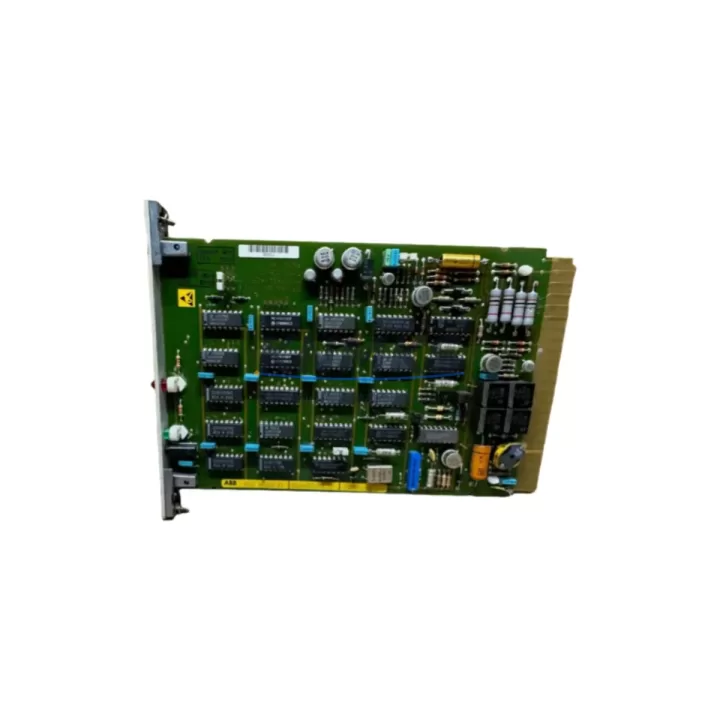
ABB HE665700-318/31 Migration-Ready Analog Input for Legacy Control Systems
The ABB HE665700-318/31 is a migration-ready analog input module engineered for direct replacement within ABB Harmony DCS environments and legacy distributed control architectures. As aging control infrastructure reaches end-of-support milestones, maintenance engineers and system integrators face mounting pressure to source verified, drop-in compatible spare parts that preserve existing program logic, wiring topology, and communication integrity without triggering full-system overhauls. The HE665700-318/31 addresses this challenge by delivering hardware-level compatibility with the original Harmony I/O backplane, retaining the same terminal block pinout, channel count, and signal conditioning characteristics as the discontinued predecessor module.
For facilities operating ABB Harmony, Advant, or MOD 300 control platforms, the HE665700-318/31 slots directly into the existing rack without requiring backplane rewiring or address reassignment. Engineers replacing a failed or end-of-life analog input card can retain the original field wiring, preserve the existing I/O map in the DCS controller database, and avoid reconfiguring HMI faceplates tied to that I/O block. This dramatically reduces the engineering hours required per replacement event and keeps planned maintenance windows within acceptable downtime budgets.
When planning a retrofit around the HE665700-318/31, the first verification step is confirming available power budget on the carrier module or I/O bus. Harmony analog input modules draw regulated 24 VDC from the backplane; if the existing power supply module — such as an ABB PP825 or equivalent Harmony power conditioner — is already near capacity due to added I/O expansion, a power audit must precede installation. Terminal block torque specifications and shielding continuity should be confirmed against the original loop drawings before energizing the replacement card.
Backplane slot addressing is a critical checkpoint. The HE665700-318/31 inherits the hardware address set by the slot position and any DIP switch or jumper configuration on the carrier. If the original module used a non-default address assignment, that configuration must be replicated on the replacement before the DCS controller performs its I/O scan. Failure to match the address results in a module fault alarm and loss of analog input data to the control strategy, which can trigger interlock responses in safety-critical loops.
Program compatibility is generally preserved when the replacement module shares the same function block type in the DCS engineering environment. However, if the site is simultaneously migrating from an older Harmony release to a current ABB System 800xA or ABB Ability platform, the I/O module firmware version must be verified against the target controller firmware. In mixed-generation retrofits, it is common to also replace the communication interface module — for example, an S800 I/O CI801 or CI840A fieldbus coupler — to ensure the analog input data reaches the new controller over PROFIBUS DP or Ethernet/IP without protocol translation errors.
HMI screen updates are often overlooked during analog input module replacements. If the original module’s engineering tag or channel descriptor differs from the replacement’s database entry, operator displays built in ABB 800xA Graphics or legacy Harmony Operator Station screens may show stale or mismatched tag references. A pre-commissioning review of all affected HMI objects tied to the replaced I/O channels prevents post-startup alarm floods and operator confusion during the first live run after the retrofit.
For larger-scale control cabinet upgrades where multiple analog input cards are being replaced simultaneously, it is advisable to stage the work by functional loop group rather than by physical slot sequence. This approach allows the process to remain partially operational on unaffected loops while the retrofit proceeds, reducing total production impact. Companion modules commonly replaced in the same campaign include ABB AI810 or AI820 analog input modules for S800 I/O racks, TB820 or TB840 Modulebus optical link modules for inter-rack communication, and SD821 or SD822 power supply units where the existing power infrastructure is being modernized alongside the I/O layer.
All HE665700-318/31 units supplied by KNMKS are sourced from verified industrial channels, individually inspected, and shipped with a support terms confirmed by quotation covering manufacturing defects and functional performance. Pre-shipment functional testing confirms analog channel accuracy, backplane interface integrity, and firmware revision. Units are packaged in anti-static enclosures with full documentation support to facilitate customs clearance and site acceptance testing.
Migration Compatibility Table
| Parameter | HE665700-318/31 Specification | Retrofit Notes |
|---|---|---|
| Module Type | Analog Input, Harmony DCS I/O | Direct slot replacement in Harmony carrier |
| Signal Range | 4–20 mA / 1–5 V (configurable per channel) | Verify loop wiring polarity before insertion |
| Channel Count | Refer to OEM datasheet for channel density | Match original I/O map; no re-addressing required |
| Backplane Interface | Harmony I/O bus connector | Compatible with standard Harmony carrier modules |
| Power Supply | 24 VDC via backplane | Confirm power budget on existing PP825 or equivalent |
| Communication Protocol | Harmony proprietary I/O bus | For 800xA migration, add CI801/CI840A coupler |
| Firmware Compatibility | Harmony legacy firmware | Verify against target DCS controller firmware revision |
| Installation Space | Standard Harmony module form factor | No cabinet modification required for like-for-like swap |
| Terminal Wiring | Original terminal block retained | No field rewiring needed for direct replacement |
| Support terms | 12 Months | Covers manufacturing defects and functional performance |
Retrofit Planning for Existing Automation Systems
A structured retrofit plan for the HE665700-318/31 begins with a full I/O audit of the affected Harmony rack. Engineers should document the current slot assignments, module part numbers, firmware revisions, and loop tag associations before any hardware is disturbed. This baseline record becomes the reference for post-retrofit verification and is essential if the site’s safety management system requires a management-of-change (MOC) record for the modification.
Power distribution within the control cabinet must be assessed early. If the retrofit scope extends beyond a single analog input card to include replacement of adjacent TB820 Modulebus optical link modules or SD821 power supply units, the cumulative inrush current during simultaneous module insertion must remain within the cabinet’s breaker and UPS capacity. Sequenced insertion — powering one module at a time — is the recommended practice for multi-module replacement campaigns.
For sites migrating toward ABB System 800xA, the HE665700-318/31 can serve as an interim solution while the broader migration roadmap is executed in phases. During this transition period, the existing Harmony I/O infrastructure continues to serve the legacy control strategy while new 800xA engineering objects are built in parallel. When the cutover date arrives, the field wiring remains unchanged; only the backplane communication path is redirected through a new CI840A or AF100 fieldbus interface module, preserving the investment in field instrumentation and loop calibration records.
Signal isolation requirements should be reviewed for any loop where the replacement module interfaces with third-party transmitters or where ground loop issues were previously documented. In these cases, adding a DIN-rail-mounted signal isolator between the field device and the analog input terminal block eliminates common-mode noise that could degrade measurement accuracy after the module swap. Programming cable access — typically via a USB-to-serial adapter compatible with the Harmony engineering workstation — should be confirmed available on-site before the maintenance window begins, as firmware verification and channel calibration may require a live connection to the engineering environment.
Downtime Control During System Migration
Minimizing unplanned downtime during an analog input module replacement requires a disciplined pre-work sequence. Before the maintenance window opens, the control strategy should be placed in manual mode for all loops served by the HE665700-318/31, with setpoints held at last-known-good values. Field operators should be briefed on the expected duration of the I/O outage and the manual control procedures for each affected loop to maintain process continuity during the swap interval.
The original module should be removed only after confirming that the DCS controller has acknowledged the I/O fault and that no interlock or safety function is dependent on a live analog input from that slot during the replacement window. If any safety instrumented function (SIF) relies on channels within the module, the site’s safety plan must include a formal bypass authorization and compensating measure before work begins.
Insertion of the HE665700-318/31 replacement should be followed immediately by a channel-by-channel verification against the pre-work baseline: confirm that each analog input is reading within the expected engineering unit range, that no channel alarms are active in the DCS alarm summary, and that the HMI displays associated with the replaced I/O block are updating correctly. Once all channels are verified, the control loops can be returned to automatic mode in the same sequence they were placed in manual, starting with the most process-critical loop first.
Post-retrofit documentation — including the as-found and as-left module part numbers, firmware revisions, channel readings, and the names of the technicians who performed the work — should be filed in the site’s maintenance management system (CMMS) and attached to the MOC record. This documentation supports future audits, support requests, and the next planned maintenance cycle.
Retrofit Support FAQ
Q: Is the HE665700-318/31 a direct drop-in replacement for the original Harmony analog input module?
A: Yes. The HE665700-318/31 is designed for direct slot replacement in standard Harmony carrier modules. The backplane connector, terminal block pinout, and I/O bus addressing are compatible with the original module, so no field rewiring or DCS database changes are required for a like-for-like swap.
Q: What pre-shipment testing is performed on each unit?
A: Every HE665700-318/31 supplied by KNMKS undergoes functional testing prior to shipment, including analog channel accuracy verification, backplane interface integrity check, and firmware revision confirmation. Units are shipped in anti-static packaging with a test report available on request.
Q: Can this module be used during a phased migration to ABB System 800xA?
A: Yes. The HE665700-318/31 can continue to serve the legacy Harmony control strategy during a phased 800xA migration. When the cutover phase is reached, a CI840A or AF100 fieldbus interface module is added to redirect the I/O communication path to the new controller without disturbing field wiring or loop calibration.
Q: What does the support terms confirmed by quotation cover?
A: The support terms confirmed by quotation cover manufacturing defects and functional performance failures under normal operating conditions. It does not cover damage resulting from incorrect installation, overvoltage events, or unauthorized modification. Support requests are processed through KNMKS with a target response time of 2 business days.
© 2026 KNMKS. All rights reserved.
Original Source: https://knmks.com
Contact: admin@knmks.com | +86 18359268345
Product Identification
- Brand / Ecosystem
-
ABB
ABB - Model / Series
-
HE665700-318/31
Legacy Series - Product Family
- PLCs & Controllers
- Availability Status
- Available on request after model and quantity confirmation
- Inquiry Type
- B2B RFQ, replacement inquiry and project spare-part request
- Pre-Quote Check
- Exact SKU, brand, series, quantity, nameplate photos and destination country are checked before quotation
System Path
Where this product fits in the KNMKS automation structure.
Specification & Inquiry Focus
- Control platform
- PLC, PAC and modular controllers
- Common needs
- CPU, rack, power and I/O expansion
- Project support
- Replacement, cabinet build and maintenance
Buyer Confirmation
Information KNMKS checks before replying.
- Exact model
- HE665700-318/31
- Brand / ecosystem
- ABB
- Product family
- PLCs & Controllers
- Application note
- Replacement, maintenance, project build or spare-part list
- Useful photos
- Nameplate, installed unit, cabinet layout or connector side
- Delivery details
- Quantity, destination country and target schedule
Document Support
Files and notes can be confirmed during quotation.
- Product photos or nameplate confirmation when available
- Packing and delivery notes before quotation confirmation
- Support scope and delivery terms confirmed per inquiry
- Export document coordination for qualified B2B requests
Inquiry Support
- Model cross-checking before quotation
- CPU, power, rack and expansion module matching
- Support for replacement and project inquiry
What to Send Us
- Brand and exact model number: ABB HE665700-318/31
- Quantity and required delivery time
- Application, replacement requirement or nameplate photo
- Destination country and shipping preference
RFQ Preparation
This is a product inquiry page built for RFQ communication.
Fast Model Check
Send this model to KNMKS for confirmation.
Include quantity, destination country and photos if this is a maintenance replacement. The inquiry will be saved with a reference number after submission.
Brand & Compatibility Note
KNMKS displays automation product information for well-known industrial brand ecosystems and compatible replacement references. Brand names are used for product identification and compatibility reference only; final availability and commercial terms are confirmed per quotation.
 Manufacturing
 Machine Tools
 Packaging
 Energy & Power
 HMI & Displays
 Servo Systems
 Variable Frequency Drives
 Sensors