
Overview
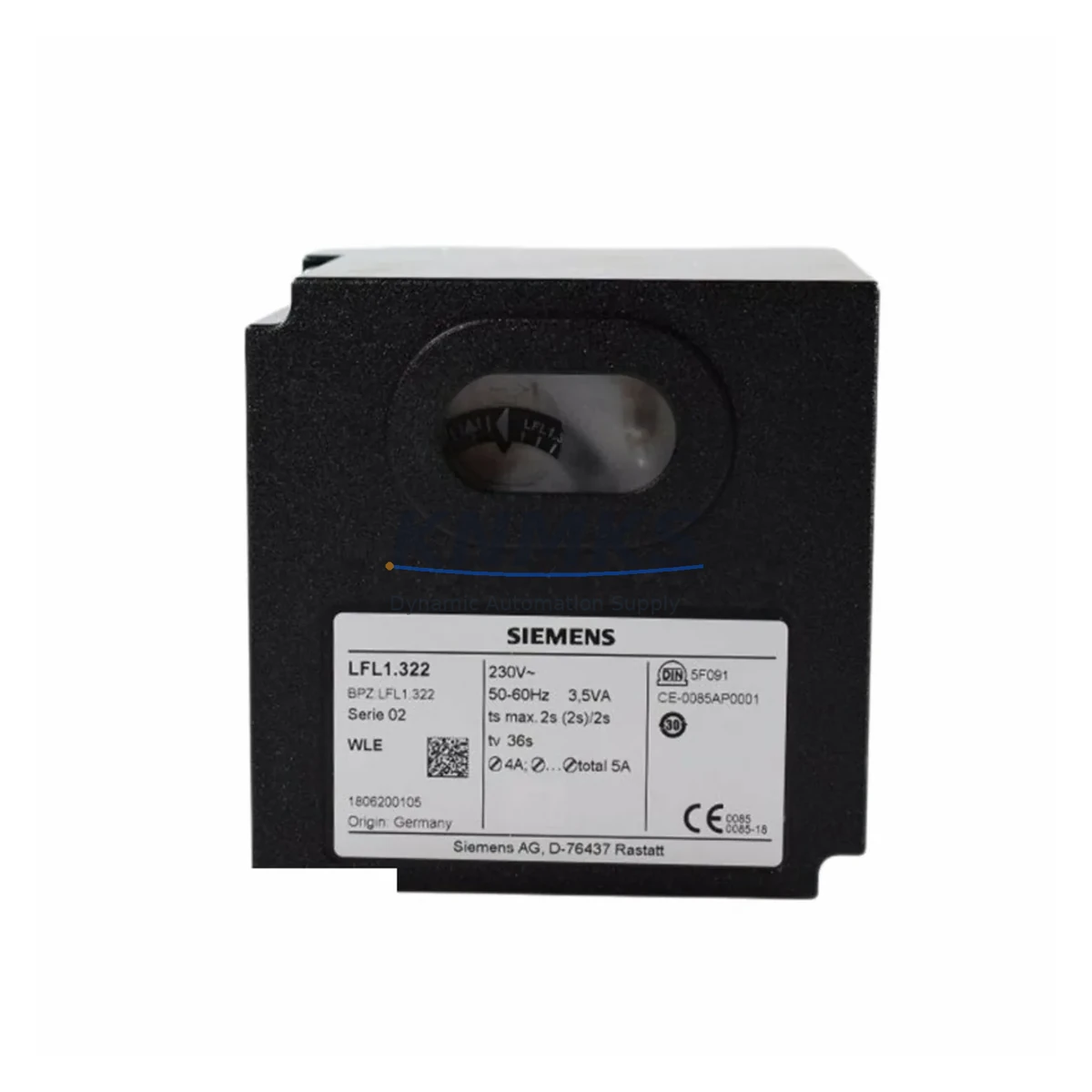
Siemens LFL1.322 Maintenance-Proven Spare Part for Factory Uptime
The Siemens LFL1.322 is an original burner control unit from the Siemens LFL1 series, engineered for reliable combustion management in industrial heating systems, boiler plants, and process burner applications. For maintenance engineers managing aging control cabinets and procurement engineers building strategic spare parts inventories, the LFL1.322 represents a critical line-replaceable unit (LRU) that directly impacts plant availability and combustion safety compliance.
When a burner control unit fails, the consequences extend beyond a single burner: entire heating circuits, process lines, or production zones can be forced offline. Stocking a verified original LFL1.322 spare eliminates the lead-time risk associated with emergency procurement and ensures that your site replacement workflow can be executed within a single maintenance window — minimizing unplanned downtime and protecting production continuity.
This unit ships after full functional inspection and bench testing. Each LFL1.322 is verified against original Siemens specifications before dispatch, and is backed by a support terms confirmed by quotation covering manufacturing defects and functional performance.
Spare Maintenance Table
| SKU / Part Number | LFL1.322 |
| Brand | Siemens |
| Series | LFL1 |
| Product Type | Burner Control Unit (Flame Safeguard Controller) |
| Supply Voltage | 220–240 V AC, 50/60 Hz (nominal) |
| Application | Industrial burner management, boiler combustion control, process heating |
| Compatibility | Siemens LFL1 series; direct replacement for LFL1.322 installations |
| Installation | DIN rail or panel mount; plug-in base compatible with LFL1 series sockets |
| Operating Environment | Industrial; suitable for control cabinet installation, IP20 enclosure minimum |
| Origin | Germany (DE) |
| Pre-shipment Testing | Functional bench test performed before dispatch |
| Support terms | 12 Months — manufacturing defects and functional performance |
| Lead Time | In-stock units ship within 1–3 business days |
Maintenance Planning for Continuous Operation
Replacing the LFL1.322 in the field is rarely an isolated task. Experienced maintenance engineers know that a burner control unit failure is often a symptom of broader stress in the combustion control circuit. Before returning the burner to service after an LFL1.322 swap, a structured inspection of the surrounding components is essential to prevent repeat failures and ensure safe recommissioning.
Flame detector and ionization electrode: The LFL1.322 interfaces directly with the flame detection circuit. A degraded ionization electrode or a contaminated UV flame detector can cause nuisance lockouts or mask genuine flame failures. Inspect and clean or replace the flame sensor as part of the same maintenance event.
Burner control panel power supply: Verify the 24 V DC or 230 V AC supply rail feeding the LFL1.322 base socket. Voltage sags or ripple on the supply bus can cause intermittent lockouts that are misdiagnosed as controller faults. A dedicated industrial DIN rail power supply module should be checked for output stability under load.
Ignition transformer and ignition leads: The ignition sequence is timed and supervised by the LFL1.322. A weakened ignition transformer or cracked ignition cable can cause ignition failures that stress the control unit’s lockout logic. Replace ignition components if carbon tracking or insulation breakdown is observed.
Air pressure switch and gas valve feedback: The LFL1.322 monitors air proving and valve position signals. Faulty pressure switches or sticky gas valve actuators generate false fault states. Confirm switch setpoints and valve response times are within specification before closing out the maintenance work order.
Terminal blocks and wiring harness: Vibration and thermal cycling in boiler rooms cause terminal block loosening and conductor fatigue. Inspect all wiring connections at the LFL1 base socket, including the neutral, live, and signal terminals. Phoenix Contact or Weidmüller-style screw terminal blocks in the same cabinet should be torque-checked.
Control cabinet thermal management: Excessive cabinet temperatures accelerate component aging across the entire burner control system. Verify that cabinet ventilation, fan filters, and any thermostat-controlled cooling units are functional. Overtemperature conditions are a leading cause of premature LFL1 series controller failure.
Building a site-level spare parts kit around the LFL1.322 — including a spare flame detector, ignition transformer, and terminal block set — reduces mean time to repair (MTTR) and supports a proactive maintenance posture rather than a reactive one.
Site Replacement Workflow
Step 1 — Isolate and de-energize: Shut down the burner and isolate the control panel from the mains supply. Follow site lockout/tagout (LOTO) procedures before opening the cabinet.
Step 2 — Document existing wiring: Photograph the LFL1.322 base socket wiring and record all terminal assignments before disconnection. Cross-reference against the original Siemens LFL1 wiring diagram for your installation.
Step 3 — Remove the failed unit: Unplug the LFL1.322 from its base socket. Inspect the socket contacts for corrosion or heat damage. Clean or replace the socket if contact resistance is elevated.
Step 4 — Install the replacement LFL1.322: Seat the new unit firmly into the base socket. Confirm the locking tab engages correctly. Do not force the unit — misalignment can damage the socket pins.
Step 5 — Verify wiring and parameters: Confirm all wiring connections match the documented configuration. If the LFL1.322 variant includes adjustable timing parameters, verify settings match the original commissioning record.
Step 6 — Recommission and test: Re-energize the panel and perform a full burner start sequence. Observe the ignition, flame establishment, and run phases. Confirm no lockout codes are generated. Log the replacement in the site maintenance record.
This workflow is compatible with direct replacement of legacy LFL1.322 installations without requiring control system reprogramming or panel rewiring, preserving system compatibility and reducing commissioning time.
Spare Parts Support FAQ
Q: Is the LFL1.322 a direct drop-in replacement for existing LFL1 series installations?
A: Yes. The LFL1.322 is designed for plug-in replacement within the LFL1 series base socket system. No rewiring is required for like-for-like substitution. Always verify the variant suffix and timing parameters match your original installation specification before commissioning.
Q: What pre-shipment testing is performed on each LFL1.322 unit?
A: Each unit undergoes a functional bench test simulating the burner start sequence, flame signal response, and lockout behavior before dispatch. Units that do not meet original Siemens performance specifications are not shipped. Test records are available on request.
Q: How should the LFL1.322 be stored as a long-term inventory spare?
A: Store in the original packaging in a dry, temperature-controlled environment (5–40°C, <75% RH non-condensing). Avoid storage near strong electromagnetic fields or corrosive atmospheres. Inspect annually for packaging integrity. Shelf life under proper storage conditions exceeds five years.
Q: What is covered under the support terms confirmed by quotation?
A: The support terms confirmed by quotation cover manufacturing defects and functional performance failures under normal operating conditions. It does not cover damage caused by incorrect installation, overvoltage events, or operation outside the specified environmental range. Support requests are supported by our technical team with replacement or repair at no additional cost.
© 2026 KNMKS. All rights reserved.
Original Source: https://knmks.com
Contact: admin@knmks.com | +86 18359268345
Product Identification
- Brand / Ecosystem
-
Siemens
Siemens - Model / Series
- LFL1.322
- Product Family
- Other Components
- Availability Status
- Available on request after model and quantity confirmation
- Inquiry Type
- B2B RFQ, replacement inquiry and project spare-part request
- Pre-Quote Check
- Exact SKU, brand, series, quantity, nameplate photos and destination country are checked before quotation
System Path
Where this product fits in the KNMKS automation structure.
Specification & Inquiry Focus
- Component range
- Breakers, terminals and cabinet accessories
- Common needs
- Model, photo and installation requirement
- Project support
- Maintenance and mixed spare-part inquiry
Buyer Confirmation
Information KNMKS checks before replying.
- Exact model
- LFL1.322
- Brand / ecosystem
- Siemens
- Product family
- Other Components
- Application note
- Replacement, maintenance, project build or spare-part list
- Useful photos
- Nameplate, installed unit, cabinet layout or connector side
- Delivery details
- Quantity, destination country and target schedule
Document Support
Files and notes can be confirmed during quotation.
- Product photos or nameplate confirmation when available
- Packing and delivery notes before quotation confirmation
- Support scope and delivery terms confirmed per inquiry
- Export document coordination for qualified B2B requests
Inquiry Support
- Mixed automation spare parts inquiry
- Cabinet component and accessory support
- Model identification from photos or labels
What to Send Us
- Brand and exact model number: Siemens LFL1.322
- Quantity and required delivery time
- Application, replacement requirement or nameplate photo
- Destination country and shipping preference
RFQ Preparation
This is a product inquiry page built for RFQ communication.
Fast Model Check
Send this model to KNMKS for confirmation.
Include quantity, destination country and photos if this is a maintenance replacement. The inquiry will be saved with a reference number after submission.
Brand & Compatibility Note
KNMKS displays automation product information for well-known industrial brand ecosystems and compatible replacement references. Brand names are used for product identification and compatibility reference only; final availability and commercial terms are confirmed per quotation.
 Manufacturing
 Machine Tools
 Packaging
 Energy & Power
 PLCs & Controllers
 HMI & Displays
 Servo Systems
 Variable Frequency Drives