
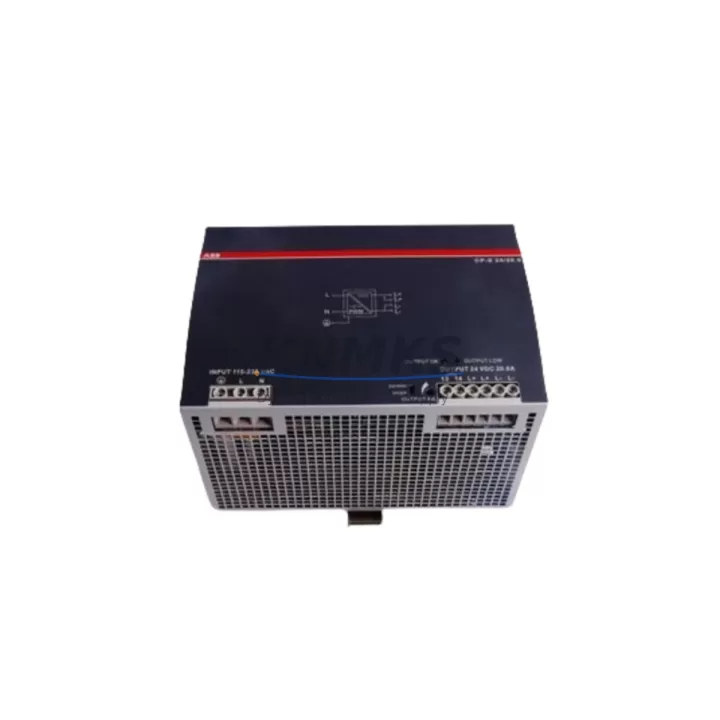
Overview
ABB VPM810 Migration-Ready Valve Position Module for Legacy Control Systems
The ABB VPM810 is a valve position module engineered for the AC500 PLC platform, widely deployed across process automation, water treatment, oil & gas, and discrete manufacturing environments. As legacy control architectures approach end-of-life, the VPM810 has become a critical component in retrofit projects where maintaining valve feedback accuracy — without redesigning the entire control loop — is the primary engineering objective.
For facilities running older ABB AC500 configurations alongside discontinued I/O modules or aging communication backplanes, the VPM810 provides a direct migration path. Its terminal layout is compatible with standard 24 VDC wiring schemes, and its signal interface aligns with the AC500’s native I/O addressing structure, reducing the need for intermediate signal conditioning or custom wiring adapters during replacement.
Before committing to a retrofit using the VPM810, engineers should verify the following: available power budget on the existing power supply module (such as the CP502 or CP503 series), backplane slot availability within the current rack configuration, module address assignment within the PLC program, and whether the existing HMI screens reference valve position tags that will need to be remapped. In most AC500 retrofit scenarios, the VPM810 can be installed without modifying the core program logic, provided the I/O channel mapping is preserved.
Migration Compatibility Table
| Parameter | Details |
|---|---|
| Compatible Platform | ABB AC500 PLC Series |
| Replaces / Upgrades | Legacy AC500 valve position modules (discontinued variants) |
| Terminal Wiring | Standard 24 VDC; compatible with existing field wiring harnesses |
| Backplane Interface | AC500 standard backplane slot; verify rack generation before installation |
| Communication Protocol | AC500 internal bus; no external protocol adapter required |
| Module Addressing | Configurable via Automation Builder; verify existing address map before swap |
| Firmware Compatibility | Pre-shipment firmware verification included; confirm AC500 CPU firmware version |
| HMI Integration | Tag remapping may be required if HMI references legacy module addresses |
| Installation Space | Standard AC500 module footprint; confirm rack slot dimensions |
| Support terms | support terms confirmed by quotation | Pre-shipment functional test included |
Retrofit Planning for Existing Automation Systems
A successful VPM810 retrofit begins well before the module arrives on-site. The first step is a full audit of the existing control cabinet: confirm that the AC500 power supply module — typically a CP502 or CP503 — can support the additional load introduced by the replacement module. In aging installations, power budgets are often tighter than the original design documents suggest, particularly when additional I/O expansion modules or communication modules have been added over the years.
Next, review the rack and backplane configuration. The VPM810 occupies a standard AC500 backplane slot, but older rack generations may have dimensional or connector differences that affect compatibility. If the existing rack is a TB511 or TB521 series, slot alignment should be confirmed against the VPM810 datasheet before ordering.
Communication continuity is another key consideration. In systems where the AC500 CPU communicates with upstream SCADA or DCS platforms via PROFIBUS DP or Modbus TCP — often through a dedicated communication module such as the CM572-DP — the VPM810 replacement should not disrupt the communication chain. However, if the legacy module occupied a slot that affected the communication module’s addressing, a full communication link test should be performed after installation.
For facilities that have expanded their I/O architecture using SM560 or SM561 signal modules, the VPM810 installation should be coordinated with the existing I/O map to avoid address conflicts. In some cases, a partial program download — rather than a full CPU restart — can be used to activate the new module configuration while keeping other control loops live, significantly reducing process downtime.
Finally, if the control system includes an ABB CP600 or CP620 HMI panel, valve position display screens should be reviewed before the cutover. Tag names and I/O channel references embedded in the HMI project may need to be updated to reflect the new module’s address, particularly if the legacy module used a non-standard channel offset.
Downtime Control During System Migration
Minimizing unplanned downtime during a VPM810 swap requires a structured pre-migration checklist. Begin by exporting the current PLC program from the AC500 CPU using ABB Automation Builder, and store a verified backup offline before any hardware changes are made. This ensures that if the replacement introduces unexpected behavior, the original logic can be restored within minutes.
Where process conditions allow, consider performing the module swap during a scheduled maintenance window rather than an emergency replacement. This allows time for a cold-start verification sequence: power down the rack, remove the legacy module, seat the VPM810, restore power, and confirm that the CPU recognizes the new module before re-enabling valve control outputs.
In installations where continuous valve feedback is critical — such as in pressure regulation or flow control loops — a temporary bypass using a portable signal simulator can maintain loop integrity during the physical swap. Once the VPM810 is confirmed online and the valve position feedback is verified against a known reference position, the bypass can be removed and normal control restored.
All units supplied are pre-tested prior to dispatch. Each VPM810 undergoes a functional verification sequence covering signal output accuracy, terminal continuity, and backplane communication handshake. This pre-shipment testing protocol reduces the risk of DOA failures and supports faster on-site commissioning, particularly in remote or difficult-to-access installations.
Retrofit Support FAQ
Q: Is the VPM810 a direct drop-in replacement for the legacy AC500 valve position module?
A: In most AC500 installations, yes. The VPM810 uses the same backplane connector and terminal layout as the standard AC500 module family. However, engineers should verify the rack generation, slot address, and PLC program I/O mapping before installation to confirm full compatibility.
Q: What commissioning steps are required after installing the VPM810?
A: After seating the module, use ABB Automation Builder to confirm that the CPU has recognized the new module at the correct rack address. Perform a valve position calibration sequence if the process requires high-accuracy feedback. If the system includes an HMI, verify that valve position tags are displaying correctly before returning the loop to automatic control.
Q: How is the VPM810 wired into an existing control cabinet?
A: The VPM810 uses standard screw-terminal connections compatible with 24 VDC field wiring. In most retrofit scenarios, existing field cables can be reconnected directly to the VPM810 terminals without modification. Confirm terminal polarity and shielding requirements against the VPM810 wiring diagram before energizing.
Q: What support terms and stock availability does KNMKS provide for the VPM810?
A: All VPM810 units supplied by KNMKS carry a support terms confirmed by quotation covering manufacturing defects and functional failures under normal operating conditions. Units are pre-tested before dispatch. Stock is maintained for immediate shipment; contact the sales team to confirm current availability and lead times for your project schedule.
—
© 2026 KNMKS. All rights reserved.
Original Source: https://knmks.com
Contact: admin@knmks.com | +86 18359268345
Product Identification
- Brand / Ecosystem
-
ABB
ABB - Model / Series
-
VPM810
AC500 Series - Product Family
- PLCs & Controllers
- Availability Status
- Available on request after model and quantity confirmation
- Inquiry Type
- B2B RFQ, replacement inquiry and project spare-part request
- Pre-Quote Check
- Exact SKU, brand, series, quantity, nameplate photos and destination country are checked before quotation
System Path
Where this product fits in the KNMKS automation structure.
Specification & Inquiry Focus
- Control platform
- PLC, PAC and modular controllers
- Common needs
- CPU, rack, power and I/O expansion
- Project support
- Replacement, cabinet build and maintenance
Buyer Confirmation
Information KNMKS checks before replying.
- Exact model
- VPM810
- Brand / ecosystem
- ABB
- Product family
- PLCs & Controllers
- Application note
- Replacement, maintenance, project build or spare-part list
- Useful photos
- Nameplate, installed unit, cabinet layout or connector side
- Delivery details
- Quantity, destination country and target schedule
Document Support
Files and notes can be confirmed during quotation.
- Product photos or nameplate confirmation when available
- Packing and delivery notes before quotation confirmation
- Support scope and delivery terms confirmed per inquiry
- Export document coordination for qualified B2B requests
Inquiry Support
- Model cross-checking before quotation
- CPU, power, rack and expansion module matching
- Support for replacement and project inquiry
What to Send Us
- Brand and exact model number: ABB VPM810
- Quantity and required delivery time
- Application, replacement requirement or nameplate photo
- Destination country and shipping preference
RFQ Preparation
This is a product inquiry page built for RFQ communication.
Fast Model Check
Send this model to KNMKS for confirmation.
Include quantity, destination country and photos if this is a maintenance replacement. The inquiry will be saved with a reference number after submission.
Brand & Compatibility Note
KNMKS displays automation product information for well-known industrial brand ecosystems and compatible replacement references. Brand names are used for product identification and compatibility reference only; final availability and commercial terms are confirmed per quotation.
 Manufacturing
 Machine Tools
 Packaging
 Energy & Power
 HMI & Displays
 Servo Systems
 Variable Frequency Drives
 Sensors