
Overview
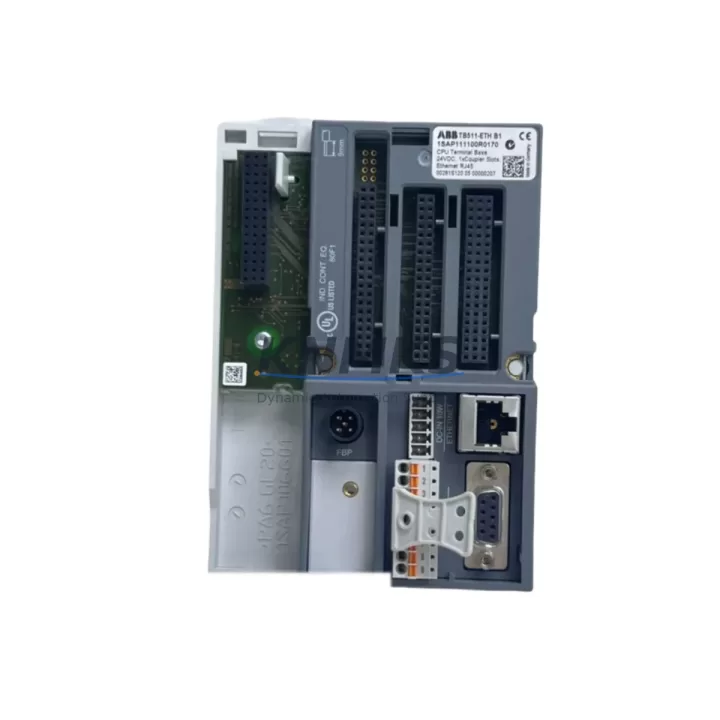
ABB TB511-ETH Migration-Ready Terminal Base for AC500 Legacy Control Systems
The ABB TB511-ETH (1SAP111100R0170) is a migration-ready terminal base engineered for the AC500 PLC platform, providing a direct mechanical and electrical interface between AC500 CPU modules and field I/O wiring. As legacy control architectures built around earlier ABB Advant, AC31, or first-generation AC500 hardware approach end-of-life, the TB511-ETH serves as a critical enabler for phased system modernization — allowing engineers to retain existing cabinet layouts, terminal wiring, and DIN rail mounting while upgrading the control logic layer.
This terminal base supports Ethernet-based communication protocols including Modbus TCP and PROFINET IO, making it fully compatible with modern supervisory systems, SCADA platforms, and distributed control architectures. For facilities running legacy serial-based communication — such as Modbus RTU or PROFIBUS DP — the TB511-ETH provides a validated migration path without requiring full cabinet redesign or rewiring of field instrumentation.
When planning a retrofit around the TB511-ETH, engineers must verify several key parameters before commissioning. Power supply capacity is the first checkpoint: the AC500 backplane draws regulated 24 VDC, and existing power supply modules such as the ABB CP502 or CP503 CPU modules must be confirmed against the total current budget of all installed I/O modules. If the legacy cabinet uses an older ABB PS501 or third-party 24 VDC rail supply, load calculations should account for the Ethernet interface current draw of the TB511-ETH.
Terminal wiring and backplane interface compatibility is the second critical area. The TB511-ETH uses a standardized 24-pin backplane connector that mates directly with AC500 I/O modules such as the DC532 digital input module and AX522 analog I/O module. Field wiring connected to the original terminal base can typically be retained without modification, provided the terminal pitch and conductor cross-section remain within specification. Engineers should document all existing terminal assignments before removal of the legacy base to avoid wiring errors during reinstallation.
Module addressing and program compatibility require careful attention during migration. AC500 CPU modules programmed in CoDeSys 2.3 or the newer Automation Builder environment may require I/O address remapping if the physical slot configuration changes. When replacing a non-Ethernet terminal base with the TB511-ETH, the Ethernet port introduces a new network node that must be assigned a static IP address and integrated into the plant network topology. PROFINET device names must be configured in the engineering tool before the first power-on to avoid address conflicts with existing network nodes.
For systems that include HMI panels — such as ABB CP600 series operator panels or third-party Weintek/Siemens TP panels — the migration to TB511-ETH may require updating communication driver configurations to reflect the new Ethernet-based data exchange path. Legacy HMI screens built around serial polling cycles may need refresh rate adjustments to align with Ethernet response times.
Installation space confirmation is essential before ordering. The TB511-ETH occupies a standard AC500 DIN rail slot width and is compatible with standard 35 mm DIN rail mounting. Cabinet depth must accommodate the Ethernet RJ45 port and cable bend radius on the front face of the module. In compact control cabinets, a minimum clearance of 80 mm in front of the module face is recommended to allow cable management without stressing the connector.
Firmware version compatibility between the TB511-ETH and the installed AC500 CPU must be verified prior to commissioning. ABB publishes firmware compatibility matrices in the AC500 system manual; engineers should confirm that the CPU firmware version supports the Ethernet terminal base variant. In some legacy installations, a CPU firmware upgrade may be required before the TB511-ETH is recognized correctly on the backplane.
Field commissioning of the TB511-ETH follows a structured sequence: physical installation and DIN rail mounting, Ethernet cable connection and IP address assignment, CPU program download via Automation Builder, I/O force test to verify field wiring continuity, and final functional test under live process conditions. For critical process applications, a parallel run period — where the legacy system remains energized alongside the new module — is strongly recommended to validate output behavior before full cutover.
All TB511-ETH units supplied by KNMKS are sourced from authorized distribution channels and undergo pre-shipment functional verification. Each unit is covered by a support terms confirmed by quotation against manufacturing defects, with global delivery details confirmed by RFQ from regional stock warehouses to minimize lead time for urgent maintenance and retrofit projects.
Migration Compatibility Table
| Parameter | TB511-ETH (1SAP111100R0170) | Legacy / Predecessor | Migration Note |
|---|---|---|---|
| Backplane Interface | AC500 24-pin standard backplane | AC500 non-ETH terminal base | Direct mechanical fit; verify CPU firmware |
| Communication Protocol | Modbus TCP, PROFINET IO | Modbus RTU, PROFIBUS DP | Protocol migration required; update HMI drivers |
| Power Supply | 24 VDC (backplane powered) | 24 VDC rail supply | Verify total current budget including ETH port |
| DIN Rail Mounting | 35 mm standard DIN rail | 35 mm standard DIN rail | No mechanical change required |
| I/O Module Compatibility | DC532, AX522, DA501 and AC500 I/O range | AC500 I/O modules | Full compatibility; verify slot addressing |
| IP Address Assignment | Static IP via Automation Builder | N/A (serial-based) | Assign before first power-on; avoid conflicts |
| Firmware Requirement | AC500 CPU firmware ≥ compatible version | Legacy CPU firmware | Check ABB compatibility matrix; upgrade if needed |
| Cabinet Depth Clearance | Min. 80 mm front clearance (RJ45 + cable) | Varies | Confirm before installation in compact cabinets |
| Support terms | support terms confirmed by quotation (KNMKS) | Covers manufacturing defects; fast replacement | |
Retrofit Planning for Existing Automation Systems
A successful retrofit centered on the TB511-ETH requires a structured bill-of-materials review across the entire control node. In a typical AC500-based control cabinet, the terminal base interfaces with the AC500 CPU module (e.g., PM573-ETH or PM583-ETH) at the top of the rack, with I/O modules occupying adjacent slots. Engineers planning a migration should audit the full rack population: digital input modules such as the DC532, analog output modules such as the DA501, and communication interface modules such as the CI590-CS31-HA for CS31 bus extension must all be confirmed for compatibility with the new Ethernet-based terminal base configuration.
Power distribution within the cabinet should be reviewed in parallel. If the existing installation uses a legacy ABB CP502 power supply module or a third-party 24 VDC DIN rail supply, the additional current draw introduced by the Ethernet interface of the TB511-ETH must be factored into the load calculation. In multi-rack installations, the TB521-ETH expansion terminal base may be required to extend the I/O configuration beyond the primary rack, and its power budget must be included in the overall supply sizing.
For installations that include signal conditioning or field isolation — common in process industries where 4–20 mA loops or thermocouple inputs are present — signal isolator modules installed between field instruments and the AC500 I/O terminals should be verified for loop power compatibility with the new configuration. Programming cables and diagnostic tools, including the ABB TK503 programming cable or Ethernet-based direct connection via Automation Builder, should be prepared before the maintenance window begins to minimize time spent on tool setup during the cutover.
Downtime Control During System Migration
Minimizing unplanned downtime during a terminal base migration requires preparation that begins weeks before the physical swap. The first priority is a complete backup of the existing CPU program, including all variable declarations, I/O mappings, PID tuning parameters, and communication configurations. Automation Builder’s project archive function should be used to create a timestamped backup stored on at least two independent media before any hardware is disturbed.
Where process continuity is critical, a parallel energization strategy is recommended: the new TB511-ETH and associated CPU module are installed in a temporary rack position and powered up alongside the legacy system. I/O signals are verified against the live process values before the legacy system is de-energized and field wiring is transferred to the new terminal base. This approach limits the actual control interruption to the duration of the wiring transfer — typically 15 to 45 minutes for a single rack — rather than the full commissioning period.
HMI screens and SCADA tags referencing the legacy communication path must be updated before cutover. For PROFINET-based migrations, the PROFINET device name and IP address of the TB511-ETH must be pre-configured and validated in the engineering tool so that the HMI re-establishes communication automatically upon network reconnection. Operators should be briefed on expected alarm behavior during the cutover window to avoid unnecessary process interventions. Post-cutover, a 24-hour monitoring period with engineering staff on standby is standard practice for critical process applications.
Retrofit Support FAQ
Q1: Is the TB511-ETH a direct drop-in replacement for non-Ethernet AC500 terminal bases?
Mechanically, yes — the TB511-ETH uses the same 35 mm DIN rail footprint and 24-pin backplane connector as standard AC500 terminal bases. However, the addition of the Ethernet port requires IP address configuration and CPU firmware verification before the module will operate correctly. Engineers should not assume a purely plug-and-play swap without completing the firmware and network configuration steps.
Q2: What commissioning steps are required after installing the TB511-ETH?
The standard commissioning sequence includes: (1) physical installation and DIN rail mounting, (2) Ethernet cable connection and static IP assignment via Automation Builder, (3) PROFINET device name configuration if applicable, (4) CPU program download and I/O force test, and (5) functional verification under live process conditions. Pre-shipment testing by KNMKS confirms the module powers up and communicates correctly, but site-specific network and program configuration remains the responsibility of the commissioning engineer.
Q3: Can the existing field wiring be reused when replacing the terminal base?
In most cases, yes. The TB511-ETH retains the same terminal wiring interface as standard AC500 terminal bases, so field cables connected to the original base can typically be transferred without modification. Engineers should document all terminal assignments before removal and verify conductor cross-section and terminal torque specifications during reinstallation to ensure reliable field connections.
Q4: What support terms and stock availability does KNMKS provide for the TB511-ETH?
KNMKS maintains regional stock of the TB511-ETH (1SAP111100R0170) to support urgent retrofit and maintenance requirements. All units are covered by a support terms confirmed by quotation against manufacturing defects from the date of shipment. Pre-shipment functional testing is performed on every unit. For volume orders or blanket stock programs supporting multi-site maintenance contracts, contact the KNMKS sales team directly to discuss allocation and lead time commitments.
© 2026 KNMKS. All rights reserved.
Original Source: https://knmks.com
Contact: admin@knmks.com | +86 18359268345
Product Identification
- Brand / Ecosystem
-
ABB
ABB - Model / Series
-
TB511-ETH 1SAP111100R0170
AC500 Series - Product Family
- PLCs & Controllers
- Availability Status
- Available on request after model and quantity confirmation
- Inquiry Type
- B2B RFQ, replacement inquiry and project spare-part request
- Pre-Quote Check
- Exact SKU, brand, series, quantity, nameplate photos and destination country are checked before quotation
System Path
Where this product fits in the KNMKS automation structure.
Specification & Inquiry Focus
- Control platform
- PLC, PAC and modular controllers
- Common needs
- CPU, rack, power and I/O expansion
- Project support
- Replacement, cabinet build and maintenance
Buyer Confirmation
Information KNMKS checks before replying.
- Exact model
- TB511-ETH 1SAP111100R0170
- Brand / ecosystem
- ABB
- Product family
- PLCs & Controllers
- Application note
- Replacement, maintenance, project build or spare-part list
- Useful photos
- Nameplate, installed unit, cabinet layout or connector side
- Delivery details
- Quantity, destination country and target schedule
Document Support
Files and notes can be confirmed during quotation.
- Product photos or nameplate confirmation when available
- Packing and delivery notes before quotation confirmation
- Support scope and delivery terms confirmed per inquiry
- Export document coordination for qualified B2B requests
Inquiry Support
- Model cross-checking before quotation
- CPU, power, rack and expansion module matching
- Support for replacement and project inquiry
What to Send Us
- Brand and exact model number: ABB TB511-ETH 1SAP111100R0170
- Quantity and required delivery time
- Application, replacement requirement or nameplate photo
- Destination country and shipping preference
RFQ Preparation
This is a product inquiry page built for RFQ communication.
Fast Model Check
Send this model to KNMKS for confirmation.
Include quantity, destination country and photos if this is a maintenance replacement. The inquiry will be saved with a reference number after submission.
Brand & Compatibility Note
KNMKS displays automation product information for well-known industrial brand ecosystems and compatible replacement references. Brand names are used for product identification and compatibility reference only; final availability and commercial terms are confirmed per quotation.
 Manufacturing
 Machine Tools
 Packaging
 Energy & Power
 HMI & Displays
 Servo Systems
 Variable Frequency Drives
 Sensors