
Overview
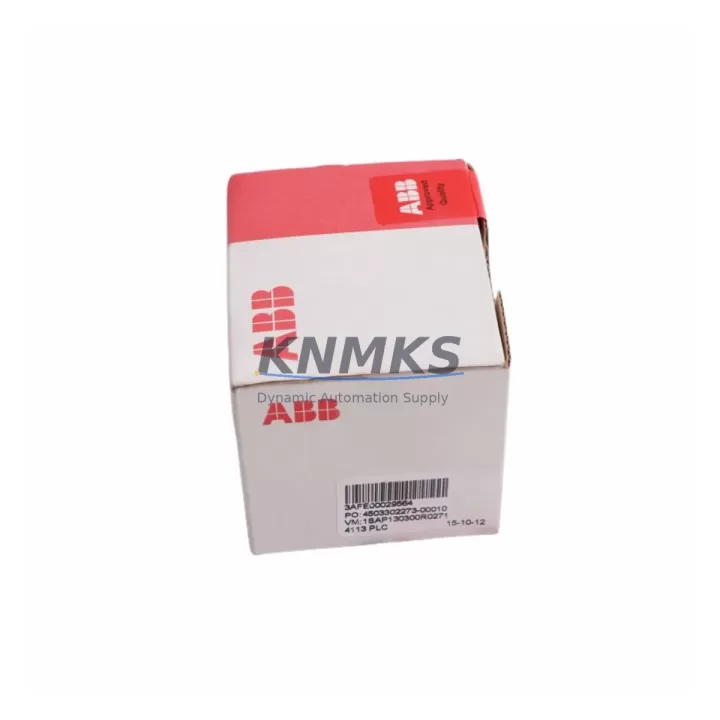
ABB PM573-ETH Migration-Ready CPU for Legacy AC500 Control Systems
The ABB PM573-ETH is a high-performance CPU module designed for the AC500 programmable logic controller platform, and it stands as one of the most practical migration targets for facilities operating legacy PM571 or PM572 processors that have reached end-of-life or are no longer supported under active ABB firmware maintenance cycles. As industrial plants face increasing pressure to modernize aging control infrastructure without full system replacement, the PM573-ETH offers a cost-effective, drop-in-compatible upgrade path that preserves existing rack architecture, terminal wiring, and program logic while introducing integrated Ethernet connectivity that legacy predecessors lacked.
The PM573-ETH is built around the AC500 backplane standard, meaning it installs directly into existing TB511, TB521, or TB541 terminal base units without mechanical modification. Engineers migrating from a PM571 or PM572 will find that the physical footprint, DIN rail mounting profile, and backplane connector pinout remain consistent, significantly reducing installation time and the risk of wiring errors during cutover. Power supply requirements are compatible with the existing PS501 or PS502 power supply modules already deployed in most AC500 cabinets, so power capacity planning is straightforward — the PM573-ETH draws within the same range as its predecessors and does not require a power supply upgrade in the majority of retrofit scenarios.
Before initiating a migration, engineers should verify the firmware version loaded on the replacement unit against the version used in the original program development environment. ABB Control Builder Plus projects compiled under older toolchain versions may require a recompile or minor variable mapping adjustment when transferred to the PM573-ETH. In most cases, the structured text, function block diagram, and ladder logic elements transfer cleanly, but any custom communication function blocks written for the legacy serial CM572-DP PROFIBUS master or CM574-RS serial communication module should be reviewed for compatibility with the PM573-ETH’s updated communication stack. If the existing system relied on a CM572-DP for PROFIBUS DP master communication, that module can be retained in the same rack alongside the PM573-ETH, as the AC500 backplane supports mixed-generation I/O and communication modules.
Terminal wiring on the associated DA501 or DA502 digital I/O modules does not need to be disturbed during a CPU swap. The PM573-ETH communicates with all standard AC500 I/O modules — including DA501 digital input, DA502 digital output, AX521 analog I/O, and DA522 mixed I/O — through the internal backplane bus, which remains unchanged across the PM57x CPU family. This means field wiring to terminal bases can remain intact throughout the migration, and the cutover window can be limited to the CPU module swap, program download, and functional verification sequence.
The integrated Ethernet port on the PM573-ETH opens direct connectivity to SCADA systems, HMI panels such as the CP600 series, and engineering workstations without requiring an additional CM579-ETHCAT or external Ethernet gateway. For sites where the existing HMI was connected via a serial RS-232 or RS-485 link through a CM574-RS module, the migration to Ethernet-based communication also provides an opportunity to simplify the communication architecture, reduce latency, and enable remote diagnostics. HMI screen variable mapping should be validated after the CPU swap, particularly if tag names or data block addresses were adjusted during the program recompile.
Module address configuration on the AC500 platform is handled through the hardware configuration in Control Builder Plus rather than physical DIP switches, which simplifies the migration process compared to older PLC families. Engineers should export and archive the existing hardware configuration before beginning the swap, then import it into the new project targeting the PM573-ETH to ensure I/O module addresses, communication parameters, and task cycle times are preserved accurately.
All PM573-ETH units supplied by KNMKS are sourced from authorized distribution channels and undergo pre-shipment functional verification including power-on self-test, Ethernet port continuity check, and firmware version confirmation. Each unit ships with a support terms confirmed by quotation covering manufacturing defects and is accompanied by documentation supporting customs clearance for international shipments. Typical lead time from order confirmation to dispatch is 1–3 business days for in-stock units.
Migration Compatibility Table
| Parameter | PM571 (Legacy) | PM572 (Legacy) | PM573-ETH (Replacement) |
|---|---|---|---|
| Backplane Compatibility | TB511 / TB521 | TB511 / TB521 / TB541 | TB511 / TB521 / TB541 ✓ |
| Integrated Ethernet | No | No | Yes (10/100 Mbps) |
| Program Memory | 512 KB | 1 MB | 2 MB |
| Communication Ports | RS-232 / RS-485 | RS-232 / RS-485 | Ethernet + RS-232 |
| I/O Module Compatibility | AC500 standard | AC500 standard | AC500 standard ✓ |
| Power Supply Compatibility | PS501 / PS502 | PS501 / PS502 | PS501 / PS502 ✓ |
| Control Builder Plus Support | V2.x (EOL) | V2.x (EOL) | V3.x / V4.x ✓ |
| Installation Space | Standard AC500 slot | Standard AC500 slot | Standard AC500 slot ✓ |
| Retrofit Wiring Change | — | — | None required |
| Support terms (KNMKS Supply) | — | — | 12 Months |
Retrofit Planning for Existing Automation Systems
A successful PM573-ETH retrofit begins with a thorough audit of the existing control cabinet. Engineers should document the current rack configuration, noting the position and firmware version of each installed module — including any DA501 digital input modules, AX521 analog input/output modules, and CM572-DP PROFIBUS communication modules. Photographs of terminal wiring and a full export of the Control Builder Plus project should be completed before any hardware is disturbed.
Power budget verification is the next critical step. The PS501 or PS502 power supply module feeding the rack should be checked against the total current draw of all installed modules plus the PM573-ETH. In most standard AC500 configurations, the power budget is sufficient without modification, but racks that are fully populated with high-density I/O modules such as the DA522 or AX522 should be calculated explicitly to confirm headroom.
If the existing system includes a CP600 series HMI panel communicating via serial link, the migration to the PM573-ETH’s Ethernet port provides an opportunity to upgrade the communication path simultaneously. This eliminates the need for the CM574-RS serial communication module in many installations, freeing a backplane slot for additional I/O expansion if required. The HMI project should be updated to reflect the new Ethernet IP address and communication driver before the cutover window begins.
For systems that include signal isolation between field devices and the PLC — particularly in environments with high electrical noise from variable frequency drives or large motor starters — existing signal isolators and terminal block assemblies do not need to be replaced. The PM573-ETH’s I/O interface through the AC500 backplane is fully compatible with the signal conditioning hardware already in place.
Programming cable access during commissioning is straightforward via the integrated Ethernet port, eliminating the need for a dedicated USB-to-serial programming cable that older PM571 installations required. Engineers can connect directly from a laptop running Control Builder Plus to the PM573-ETH over the plant network or a direct Ethernet crossover connection for isolated commissioning.
Downtime Control During System Migration
Minimizing production downtime during a CPU migration requires preparation that begins well before the scheduled maintenance window. The most effective approach is to pre-configure and bench-test the PM573-ETH with the migrated program in a staging environment before bringing it to the plant floor. This allows engineers to verify program execution, I/O mapping, and communication link behavior under controlled conditions, so the on-site cutover is limited to physical installation and final functional verification.
During the cutover, the sequence should follow a defined procedure: power down the rack, remove the legacy CPU module, install the PM573-ETH into the same terminal base slot, restore power, download the pre-tested program, and execute a structured I/O verification sequence before returning the system to automatic mode. Because the PM573-ETH uses the same backplane interface as the PM571 and PM572, there is no need to reconfigure I/O module addresses or rewire terminal bases, which are the two most time-consuming steps in a traditional PLC migration.
Original program logic — including PID control loops, sequence control blocks, interlock logic, and communication function blocks — is preserved through the Control Builder Plus project export and import process. Engineers should validate all safety-critical interlocks and alarm setpoints during the commissioning verification sequence before releasing the system to operations. A structured test checklist covering each I/O point, communication link, and HMI screen should be completed and signed off before the maintenance window closes.
For facilities that cannot tolerate extended downtime, a parallel-run strategy can be employed where the PM573-ETH is installed in a secondary rack and tested against live I/O signals before the final cutover. This approach requires additional hardware temporarily but provides the highest level of confidence in system behavior before the legacy CPU is decommissioned.
Retrofit Support FAQ
Q: Is the PM573-ETH a direct drop-in replacement for the PM571 and PM572?
A: Yes. The PM573-ETH installs into the same TB511, TB521, and TB541 terminal base units used by the PM571 and PM572. No mechanical modification or terminal rewiring is required. The program must be recompiled in Control Builder Plus V3.x or V4.x and downloaded to the new CPU, but the logic structure and I/O mapping are preserved.
Q: Does the PM573-ETH require a new power supply or rack?
A: In most standard AC500 configurations, the existing PS501 or PS502 power supply is sufficient. Engineers should verify the total current draw of all installed modules against the power supply’s rated output, particularly in fully populated racks. No rack replacement is required — the PM573-ETH uses the standard AC500 backplane.
Q: What pre-shipment testing is performed on KNMKS-supplied PM573-ETH units?
A: Each unit undergoes power-on self-test, Ethernet port continuity verification, and firmware version confirmation before dispatch. Units are supplied with a support terms confirmed by quotation covering manufacturing defects. Documentation supporting customs clearance is included with international shipments.
Q: Can the PM573-ETH communicate with existing PROFIBUS DP devices in the system?
A: The PM573-ETH does not include a native PROFIBUS DP master port. Existing CM572-DP PROFIBUS master modules can be retained in the same AC500 rack and will continue to operate alongside the PM573-ETH via the backplane bus. No changes to PROFIBUS device addressing or wiring are required when retaining the CM572-DP in the migrated system.
© 2026 KNMKS. All rights reserved.
Original Source: https://knmks.com
Contact: admin@knmks.com | +86 18359268345
Product Identification
- Brand / Ecosystem
-
ABB
ABB - Model / Series
-
PM573-ETH
AC500 Series - Product Family
- PLCs & Controllers
- Availability Status
- Available on request after model and quantity confirmation
- Inquiry Type
- B2B RFQ, replacement inquiry and project spare-part request
- Pre-Quote Check
- Exact SKU, brand, series, quantity, nameplate photos and destination country are checked before quotation
System Path
Where this product fits in the KNMKS automation structure.
Specification & Inquiry Focus
- Control platform
- PLC, PAC and modular controllers
- Common needs
- CPU, rack, power and I/O expansion
- Project support
- Replacement, cabinet build and maintenance
Buyer Confirmation
Information KNMKS checks before replying.
- Exact model
- PM573-ETH
- Brand / ecosystem
- ABB
- Product family
- PLCs & Controllers
- Application note
- Replacement, maintenance, project build or spare-part list
- Useful photos
- Nameplate, installed unit, cabinet layout or connector side
- Delivery details
- Quantity, destination country and target schedule
Document Support
Files and notes can be confirmed during quotation.
- Product photos or nameplate confirmation when available
- Packing and delivery notes before quotation confirmation
- Support scope and delivery terms confirmed per inquiry
- Export document coordination for qualified B2B requests
Inquiry Support
- Model cross-checking before quotation
- CPU, power, rack and expansion module matching
- Support for replacement and project inquiry
What to Send Us
- Brand and exact model number: ABB PM573-ETH
- Quantity and required delivery time
- Application, replacement requirement or nameplate photo
- Destination country and shipping preference
RFQ Preparation
This is a product inquiry page built for RFQ communication.
Fast Model Check
Send this model to KNMKS for confirmation.
Include quantity, destination country and photos if this is a maintenance replacement. The inquiry will be saved with a reference number after submission.
Brand & Compatibility Note
KNMKS displays automation product information for well-known industrial brand ecosystems and compatible replacement references. Brand names are used for product identification and compatibility reference only; final availability and commercial terms are confirmed per quotation.
 Manufacturing
 Machine Tools
 Packaging
 Energy & Power
 HMI & Displays
 Servo Systems
 Variable Frequency Drives
 Sensors