
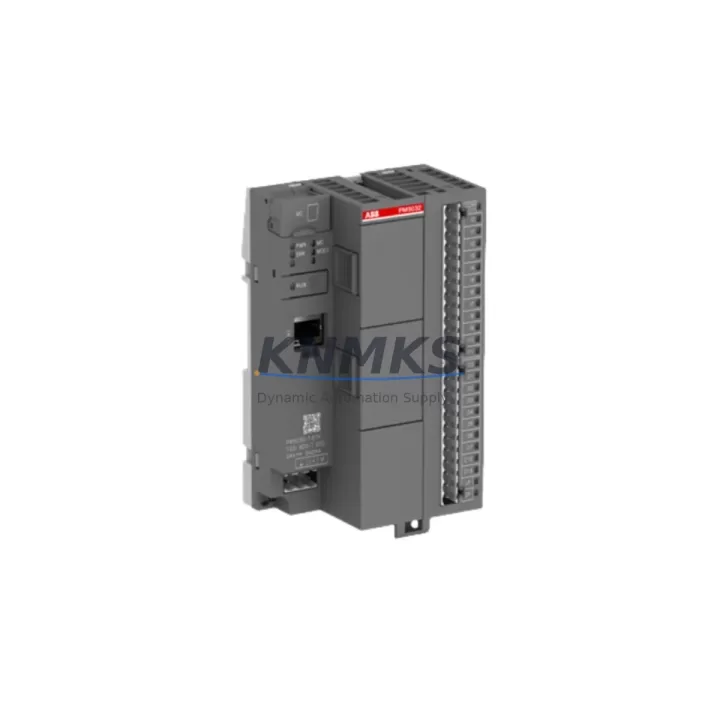
Overview
ABB PM5032-T-ETH Migration-Ready CPU for AC500 Systems: Legacy System Migration and Compatible Upgrade
The ABB PM5032-T-ETH is a high-performance CPU module engineered for the AC500 programmable logic controller platform, purpose-built to address the growing demand for legacy control system migration, discontinued spare part replacement, and control cabinet modernization. As industrial facilities face increasing pressure to extend the operational life of aging DCS and PLC infrastructure while managing obsolescence risk, the PM5032-T-ETH provides a validated, migration-ready solution that preserves existing program logic, I/O architecture, and communication topology with minimal disruption to production continuity.
Designed for direct installation into the AC500 backplane, the PM5032-T-ETH integrates onboard Ethernet connectivity, enabling seamless transition from legacy serial-based communication protocols to modern TCP/IP-based SCADA and HMI networks. Engineers replacing end-of-life PM5032 or PM5016 variants will find the PM5032-T-ETH a functionally compatible successor, retaining the same rack mounting footprint, terminal block assignments, and Automation Builder programming environment compatibility. This eliminates the need for full cabinet redesign and significantly reduces retrofit engineering hours.
During migration planning, engineers must verify several critical parameters before commissioning. Power supply capacity within the control cabinet must be confirmed against the PM5032-T-ETH’s rated consumption; in most AC500 installations, the existing PS501 or PS502 power supply modules provide adequate headroom, but aging units should be load-tested prior to cutover. Terminal wiring from field I/O to the CPU’s communication bus must be inspected for insulation integrity and correct labeling, particularly where legacy wiring documentation is incomplete. Backplane slot addressing must be re-confirmed if the CPU is being relocated within the rack, as module address conflicts can cause initialization faults that delay commissioning.
Program compatibility is a primary concern in any CPU swap. Projects developed in Automation Builder for earlier AC500 CPU generations are generally forward-compatible with the PM5032-T-ETH, but firmware version alignment must be verified before download. Where HMI panels — such as CP600 or CP635 series operator panels — are connected via Modbus TCP or PROFIBUS DP, communication link parameters including node addresses, baud rates, and polling cycles must be re-validated post-swap to ensure display integrity and alarm response accuracy.
For installations incorporating distributed I/O expansion, the PM5032-T-ETH supports connection to TB511-ETH and TB521-ETH terminal base units, allowing engineers to retain existing I/O wiring while upgrading the central processing capability. Signal isolators installed between field devices and I/O modules should be inspected during the retrofit window to confirm channel integrity, particularly in high-vibration or high-humidity environments where connector oxidation is common. Where PROFIBUS DP networks are in use, the DP800 series communication modules remain compatible with the PM5032-T-ETH, preserving the existing field device network without re-addressing.
Installation space within the control cabinet should be confirmed before ordering. The PM5032-T-ETH occupies a standard AC500 CPU slot and does not require additional DIN rail space, but adjacent modules — including analog I/O cards and communication couplers — must have adequate clearance for heat dissipation. Firmware for the PM5032-T-ETH should be sourced from the current ABB Automation Builder release to ensure compatibility with the target project version, and a pre-shipment firmware check is recommended for units sourced from third-party distributors.
All PM5032-T-ETH units supplied by KNMKS are pre-shipment tested under simulated load conditions, verifying CPU initialization, Ethernet port negotiation, and memory integrity before dispatch. Units are covered by a support terms confirmed by quotation from the date of delivery, with in-stock availability supporting emergency replacement timelines. Global dispatch is available with typical lead times of 3–7 business days depending on destination region.
Migration Compatibility Table
| Parameter | Legacy Reference | PM5032-T-ETH Specification | Migration Note |
|---|---|---|---|
| Common Replacement Targets | PM5032, PM5016, PM5016-2ETH | PM5032-T-ETH | Verify firmware version before program download |
| Backplane Interface | AC500 standard backplane | AC500 standard backplane | Direct slot-compatible; no adapter required |
| Communication Ports | Serial RS-232 / RS-485 (legacy) | Ethernet TCP/IP (onboard) | Update SCADA/HMI IP configuration post-swap |
| Programming Environment | Automation Builder (legacy versions) | Automation Builder (current) | Re-compile project under current AB version |
| Power Consumption | Varies by legacy CPU | Confirm against PS501/PS502 capacity | Load-test existing PSU before cutover |
| I/O Expansion Compatibility | TB511, TB521 terminal bases | TB511-ETH, TB521-ETH supported | Retain existing I/O wiring; re-confirm addresses |
| HMI Compatibility | CP600, CP635 series panels | Modbus TCP / PROFIBUS DP | Re-validate node addresses and polling cycles |
| Fieldbus Support | PROFIBUS DP (DP800 modules) | DP800 series compatible | No re-addressing required for existing DP network |
| Installation Footprint | Standard AC500 CPU slot | Standard AC500 CPU slot | Confirm adjacent module clearance for heat dissipation |
| Pre-Shipment Testing | — | CPU init, Ethernet, memory integrity | All units tested before dispatch |
| Support terms | — | 12 Months from delivery date | Covers manufacturing defects and functional failure |
Retrofit Planning for Existing Automation Systems
A successful AC500 retrofit begins with a structured audit of the existing control cabinet. Engineers should document the current CPU slot assignment, backplane configuration, and all installed modules — including analog input cards, digital output modules, and any communication couplers — before initiating the swap. Where the legacy CPU is a PM5032 or PM5016 variant, the PM5032-T-ETH can be installed into the same slot without mechanical modification, preserving the existing TB511-ETH or TB521-ETH terminal base wiring.
Power distribution within the cabinet must be reviewed. The PS501 or PS502 power supply modules commonly found in AC500 installations should be verified for output stability under the combined load of the new CPU and all connected I/O modules. Where power budgets are marginal, a supplementary 24 VDC rail may be required for field device circuits. Signal isolators between field transmitters and analog I/O cards should be inspected and replaced if response time or isolation resistance is degraded.
Communication architecture planning is critical. Where the legacy system used serial PROFIBUS DP via DP800 communication modules, the existing field device network can be retained without re-addressing, as the PM5032-T-ETH maintains compatibility with the DP800 series. For SCADA systems connected via Modbus TCP, the new Ethernet port on the PM5032-T-ETH simplifies network integration, but IP address assignment, subnet configuration, and firewall rules must be updated in the SCADA server before cutover. HMI panels such as CP600 or CP635 series units connected via Ethernet must have their PLC IP target updated and communication parameters re-validated.
Programming cable connections during the retrofit window should use the standard USB programming cable compatible with Automation Builder, ensuring the project can be downloaded and verified on the bench before installation. Where the existing program includes function blocks referencing legacy CPU-specific memory areas, a compatibility review in Automation Builder is recommended prior to the maintenance window to avoid unexpected runtime faults during commissioning.
Downtime Control During System Migration
Minimizing unplanned downtime during a CPU swap requires preparation that begins well before the maintenance window. The existing program should be backed up from the legacy CPU using Automation Builder’s upload function and stored in a version-controlled archive. A full I/O force table and current alarm setpoint list should be exported and reviewed so that post-swap verification can be completed systematically rather than reactively.
During the physical swap, field control continuity can be maintained by placing the process in manual mode at the DCS or SCADA level, allowing operators to hold critical setpoints while the CPU is exchanged. For processes where even brief interruptions are unacceptable, a parallel commissioning approach — where the PM5032-T-ETH is pre-configured and tested on a bench rack before the live swap — is strongly recommended. This approach allows the new CPU to be validated against the actual program and I/O configuration before the maintenance window begins, reducing in-cabinet commissioning time to a module swap and communication re-link.
Post-installation, the commissioning sequence should follow a structured checklist: confirm CPU initialization status, verify Ethernet link establishment, download and verify the program, force-test critical I/O channels, re-enable SCADA communication, and confirm HMI display integrity before returning the process to automatic control. Where PROFIBUS DP field devices are connected via DP800 modules, a DP network diagnostic scan should be performed to confirm all slave devices are online before releasing the system. The support terms confirmed by quotation on all KNMKS-supplied PM5032-T-ETH units provides additional assurance during the post-commissioning period, covering any functional failures that emerge during initial operation.
Retrofit Support FAQ
Q: Is the PM5032-T-ETH a direct replacement for the PM5032 and PM5016?
A: The PM5032-T-ETH is mechanically and electrically compatible with the AC500 backplane used by PM5032 and PM5016 variants. Program re-compilation under the current Automation Builder version is required, and firmware version alignment must be confirmed before download. Terminal wiring and I/O module assignments are retained without modification in most installations.
Q: What pre-shipment testing is performed on PM5032-T-ETH units?
A: All units supplied by KNMKS undergo pre-shipment testing covering CPU initialization, Ethernet port negotiation, onboard memory integrity, and basic I/O communication verification. Test records are available upon request. Units are dispatched only after passing all functional checks.
Q: How do I verify wiring compatibility before installation?
A: Terminal block assignments on the TB511-ETH and TB521-ETH terminal bases used with the PM5032-T-ETH are consistent with legacy AC500 terminal base configurations. Engineers should cross-reference the existing wiring diagram against the PM5032-T-ETH installation manual to confirm signal assignments, particularly for analog channels and communication ports. Where wiring documentation is incomplete, a point-to-point continuity check is recommended before powering the new CPU.
Q: What support terms and stock availability does KNMKS provide?
A: KNMKS maintains in-stock inventory of the PM5032-T-ETH to support emergency replacement and planned retrofit projects. All units are covered by a support terms confirmed by quotation from the date of delivery, covering manufacturing defects and functional failure under normal operating conditions. Global dispatch is available with typical lead times of 3–7 business days. Contact admin@knmks.com or +86 18359268345 for stock confirmation and expedited shipping options.
© 2026 KNMKS. All rights reserved.
Original Source: https://knmks.com
Contact: admin@knmks.com | +86 18359268345
Product Identification
- Brand / Ecosystem
-
ABB
ABB - Model / Series
-
PM5032-T-ETH
AC500 Series - Product Family
- PLCs & Controllers
- Availability Status
- Available on request after model and quantity confirmation
- Inquiry Type
- B2B RFQ, replacement inquiry and project spare-part request
- Pre-Quote Check
- Exact SKU, brand, series, quantity, nameplate photos and destination country are checked before quotation
System Path
Where this product fits in the KNMKS automation structure.
Specification & Inquiry Focus
- Control platform
- PLC, PAC and modular controllers
- Common needs
- CPU, rack, power and I/O expansion
- Project support
- Replacement, cabinet build and maintenance
Buyer Confirmation
Information KNMKS checks before replying.
- Exact model
- PM5032-T-ETH
- Brand / ecosystem
- ABB
- Product family
- PLCs & Controllers
- Application note
- Replacement, maintenance, project build or spare-part list
- Useful photos
- Nameplate, installed unit, cabinet layout or connector side
- Delivery details
- Quantity, destination country and target schedule
Document Support
Files and notes can be confirmed during quotation.
- Product photos or nameplate confirmation when available
- Packing and delivery notes before quotation confirmation
- Support scope and delivery terms confirmed per inquiry
- Export document coordination for qualified B2B requests
Inquiry Support
- Model cross-checking before quotation
- CPU, power, rack and expansion module matching
- Support for replacement and project inquiry
What to Send Us
- Brand and exact model number: ABB PM5032-T-ETH
- Quantity and required delivery time
- Application, replacement requirement or nameplate photo
- Destination country and shipping preference
RFQ Preparation
This is a product inquiry page built for RFQ communication.
Fast Model Check
Send this model to KNMKS for confirmation.
Include quantity, destination country and photos if this is a maintenance replacement. The inquiry will be saved with a reference number after submission.
Brand & Compatibility Note
KNMKS displays automation product information for well-known industrial brand ecosystems and compatible replacement references. Brand names are used for product identification and compatibility reference only; final availability and commercial terms are confirmed per quotation.
 Manufacturing
 Machine Tools
 Packaging
 Energy & Power
 HMI & Displays
 Servo Systems
 Variable Frequency Drives
 Sensors