
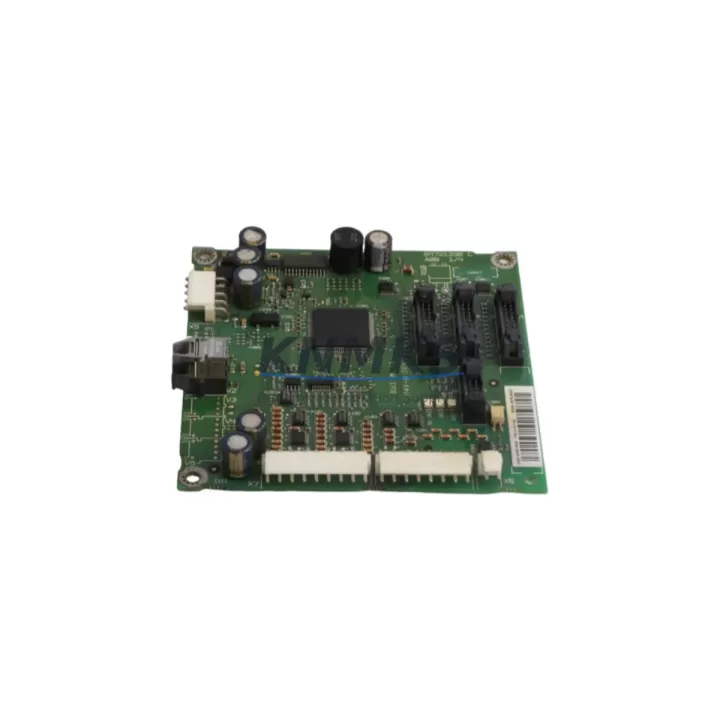
Overview
ABB AINT-02 Migration-Ready Fiber Optic Interface for Legacy Drives
The ABB AINT-02 is a fiber optic interface module engineered for seamless integration into ACS800 and ACS600 variable frequency drive platforms. As legacy drive systems approach end-of-life and OEM support windows close, the AINT-02 provides a validated, drop-in migration path that preserves existing control architecture while enabling forward compatibility with modern automation networks. Whether you are executing a planned retrofit, responding to an unplanned drive failure, or extending the operational life of a legacy control cabinet, the AINT-02 delivers the signal integrity, protocol compatibility, and installation precision required for mission-critical industrial environments.
The module interfaces directly with the RDCO-01 or RDCO-02 communication adapter boards commonly installed in ACS800 drive units, maintaining the DDCS (Distributed Drives Communication System) fiber optic ring topology without requiring reprogramming of the master controller. This is particularly significant in multi-drive systems where a single ACS800 master coordinates multiple follower drives — replacing the AINT-02 without disrupting the DDCS ring prevents cascading faults and eliminates the need for full system re-commissioning.
During retrofit planning, engineers must verify the drive’s internal backplane slot assignment, confirm that the AINT-02 is seated in the correct option slot (typically Slot 1 or Slot 2 depending on drive frame size), and validate fiber cable routing lengths against the module’s optical power budget. The AINT-02 uses ST-type fiber connectors; existing fiber harnesses from legacy AINT-01 installations are generally reusable provided cable condition and bend radius are within specification. Firmware version compatibility between the AINT-02 and the ACS800 main control board (RMIO) should be confirmed prior to energization — mismatched firmware revisions can cause fault codes F-0001 or A-0006 on startup.
Migration Compatibility Table
| Parameter | Detail |
|---|---|
| Compatible Drive Platforms | ABB ACS800, ACS600 series |
| Replaces / Supersedes | AINT-01, legacy DDCS fiber interface boards |
| Communication Protocol | DDCS (Distributed Drives Communication System) fiber optic |
| Connector Type | ST-type fiber optic (Tx / Rx) |
| Slot Installation | Option Slot 1 or Slot 2 (frame-size dependent) |
| Backplane Interface | ACS800 RMIO main control board compatible |
| Firmware Compatibility | Verify RMIO firmware version prior to installation |
| Power Supply Requirement | Supplied via drive internal backplane (no external PSU required) |
| Installation Space | Standard ACS800 option module footprint |
| Pre-Shipment Testing | Function-tested before dispatch |
| Support terms | 12 months from date of shipment |
| Origin | CN |
Retrofit Planning for Existing Automation Systems
A successful AINT-02 retrofit begins well before the module arrives on site. The following planning checklist addresses the most common failure points encountered during legacy ACS800 drive upgrades:
Power Capacity Verification: Confirm that the drive’s internal 24 VDC auxiliary supply — shared with the RMIO board and any installed RDCO-01 communication adapter — has sufficient headroom to power the AINT-02 without triggering undervoltage faults. In older ACS800 frames, the auxiliary supply may already be loaded by an NPBA-12 PROFIBUS adapter or an NMBP-01 Modbus adapter; adding the AINT-02 without auditing the supply budget can cause intermittent resets.
Terminal and Wiring Adaptation: The AINT-02 does not require external signal wiring — all communication is carried over the fiber optic link. However, if the legacy installation used an AINT-01 with a hybrid copper/fiber configuration, the copper signal wires must be properly terminated or removed to prevent ground loops. Verify that the RDCO-01 or RDCO-02 adapter board is correctly seated and that its ribbon cable to the RMIO is undamaged before installing the AINT-02.
Module Address and DDCS Ring Configuration: In a DDCS ring topology, each drive node is assigned a unique address (typically 1–12). After installing the AINT-02, confirm the node address via the ACS800 parameter group 70 (DDCS Control) and verify that the master controller — often an AC800M controller or a third-party PLC communicating via an NDNA-02 DDCS gateway — correctly enumerates the replaced node. Failure to validate node addressing is the most common cause of post-retrofit communication faults.
HMI Screen and Drive Parameter Backup: Before removing the legacy module, export a full parameter backup from the ACS800 using the DriveWindow Light software or a compatible CDP-312R control panel. This backup preserves motor data, speed references, PID tuning, and fault history. After AINT-02 installation, restore the parameter set and verify that HMI screens — particularly those displaying drive status, speed feedback, and fault codes — reflect correct values before returning the system to production.
Communication Link Validation: After installation, perform a DDCS ring integrity check by monitoring the CH0 or CH1 fiber channel status in the ACS800 parameter group 70. A healthy ring shows zero CRC errors and a stable token-passing cycle. If errors persist, inspect fiber cable cleanliness, verify connector seating, and check that the optical power level at the AINT-02 receiver is within the module’s specified sensitivity range.
Downtime Control During System Migration
Minimizing production downtime during an AINT-02 replacement requires a structured hot-swap protocol. The following approach has been validated across multiple ACS800 retrofit projects in process industries, material handling, and HVAC applications:
Pre-Outage Preparation: Complete all parameter backups, firmware version checks, and spare parts staging before the maintenance window opens. Ensure that the replacement AINT-02 has been function-tested and that all fiber cables, the RDCO-01 adapter, and any associated NMBP-01 or NPBA-12 communication modules are on hand. A pre-staged spare reduces mean time to repair (MTTR) from hours to minutes.
Controlled Shutdown Sequence: Follow the ACS800 standard shutdown procedure — ramp the drive to zero speed, disable the run command, and isolate the main contactor before opening the drive cabinet. Do not remove the AINT-02 under power; the DDCS fiber ring will generate fault codes on all connected nodes if a module is hot-removed without first placing the master controller in ring-break tolerance mode.
Program Logic Preservation: The AINT-02 replacement does not alter the ACS800’s internal application program or parameter set. However, if the drive is part of a coordinated motion system — for example, a multi-drive winder or a crane hoist using an AC800M master — verify that the master PLC program does not require a re-download after the DDCS ring is restored. Most AC800M applications handle ring re-establishment automatically, but custom function blocks may require a warm restart.
Post-Installation Commissioning: After installing the AINT-02 and restoring power, allow the DDCS ring to stabilize for 30–60 seconds before issuing a run command. Monitor the drive’s fault log for the first 10 operating cycles and confirm that speed reference tracking, torque limit response, and fault relay outputs are functioning correctly. Document the commissioning results and update the site’s maintenance record with the new module serial number and installation date.
Retrofit Support FAQ
Q1: Is the AINT-02 a direct replacement for the AINT-01?
Yes. The AINT-02 is the designated successor to the AINT-01 fiber optic interface. It occupies the same option slot, uses the same ST-type fiber connectors, and is fully compatible with the ACS800 DDCS ring topology. No parameter changes are required for a like-for-like replacement, though firmware version alignment between the AINT-02 and the RMIO board is recommended.
Q2: What pre-shipment testing is performed on the AINT-02?
Each AINT-02 unit is function-tested prior to dispatch to verify optical transmit/receive performance, backplane interface integrity, and module identification. Test records are retained and available upon request. All units ship with a support terms confirmed by quotation covering manufacturing defects and functional failures under normal operating conditions.
Q3: Can the AINT-02 be used in an ACS600 drive?
The AINT-02 is primarily specified for ACS800 platforms. Compatibility with ACS600 drives depends on the specific ACS600 frame type and the installed RMIO variant. Customers are advised to confirm the option slot specification in the ACS600 hardware manual or contact our technical team with the full drive type code before ordering.
Q4: What is the lead time and stock availability?
The AINT-02 is maintained in forward stock to support emergency replacement and planned retrofit schedules. Standard dispatch is within 1–3 business days. For bulk retrofit projects requiring multiple units, contact our sales team to confirm allocation and arrange consolidated shipment. All units are covered by a support terms confirmed by quotation from the date of shipment.
© 2026 KNMKS. All rights reserved.
Original Source: https://knmks.com
Contact: admin@knmks.com | +86 18359268345
Product Identification
- Brand / Ecosystem
-
ABB
ABB - Model / Series
-
AINT-02
S800 Series - Product Family
- Variable Frequency Drives
- Availability Status
- Available on request after model and quantity confirmation
- Inquiry Type
- B2B RFQ, replacement inquiry and project spare-part request
- Pre-Quote Check
- Exact SKU, brand, series, quantity, nameplate photos and destination country are checked before quotation
System Path
Where this product fits in the KNMKS automation structure.
Specification & Inquiry Focus
- Drive range
- AC drives, VFDs and accessories
- Common needs
- Voltage, kW/HP and load type
- Project support
- Motor control, energy saving and spares
Buyer Confirmation
Information KNMKS checks before replying.
- Exact model
- AINT-02
- Brand / ecosystem
- ABB
- Product family
- Variable Frequency Drives
- Application note
- Replacement, maintenance, project build or spare-part list
- Useful photos
- Nameplate, installed unit, cabinet layout or connector side
- Delivery details
- Quantity, destination country and target schedule
Document Support
Files and notes can be confirmed during quotation.
- Product photos or nameplate confirmation when available
- Packing and delivery notes before quotation confirmation
- Support scope and delivery terms confirmed per inquiry
- Export document coordination for qualified B2B requests
Inquiry Support
- Input/output voltage and kW/HP confirmation
- Energy-saving motor control inquiry
- Accessory and spare-unit support
What to Send Us
- Brand and exact model number: ABB AINT-02
- Quantity and required delivery time
- Application, replacement requirement or nameplate photo
- Destination country and shipping preference
RFQ Preparation
This is a product inquiry page built for RFQ communication.
Fast Model Check
Send this model to KNMKS for confirmation.
Include quantity, destination country and photos if this is a maintenance replacement. The inquiry will be saved with a reference number after submission.
Brand & Compatibility Note
KNMKS displays automation product information for well-known industrial brand ecosystems and compatible replacement references. Brand names are used for product identification and compatibility reference only; final availability and commercial terms are confirmed per quotation.
 Manufacturing
 Machine Tools
 Packaging
 Energy & Power
 PLCs & Controllers
 HMI & Displays
 Servo Systems
 Sensors