A control module can fit the rack, communicate with the controller and still be unsuitable for the cabinet where it will operate. Environmental differences can disappear from a short purchasing description, particularly when the request contains only a base model or a photograph of the front cover.
A conformally coated PLC replacement needs a comparison of several separate requirements: protection of the electronics, the enclosure, the permitted operating conditions and the other components in the installed system. “Coated,” “extended temperature” and an IP designation should not be treated as interchangeable descriptions.
What a coating tells you, and what it leaves open
Rockwell Automation’s conformal-coated and XT product profile describes coating as a protective layer on circuit-board assemblies. It also distinguishes products with additional corrosive-gas protection and identifies exceptions that require checking the individual technical data. A family label or suffix therefore needs to be read in the context of that manufacturer’s product documentation.
For an inquiry, ask which environmental specification the installed unit was selected to meet. “It has coating” is less useful than a complete order code and the relevant documented conditions. A photograph alone cannot establish the coating process or a tested environmental rating.
Keep enclosure protection separate
A coating on electronics does not establish how the installed enclosure excludes dust or water. A useful manufacturer example is ABB’s LD 810HSE Ex quick installation guide: it lists conformal coating, IP20, indoor use and non-condensing humidity as separate specifications. The coating statement does not remove those other installation conditions.
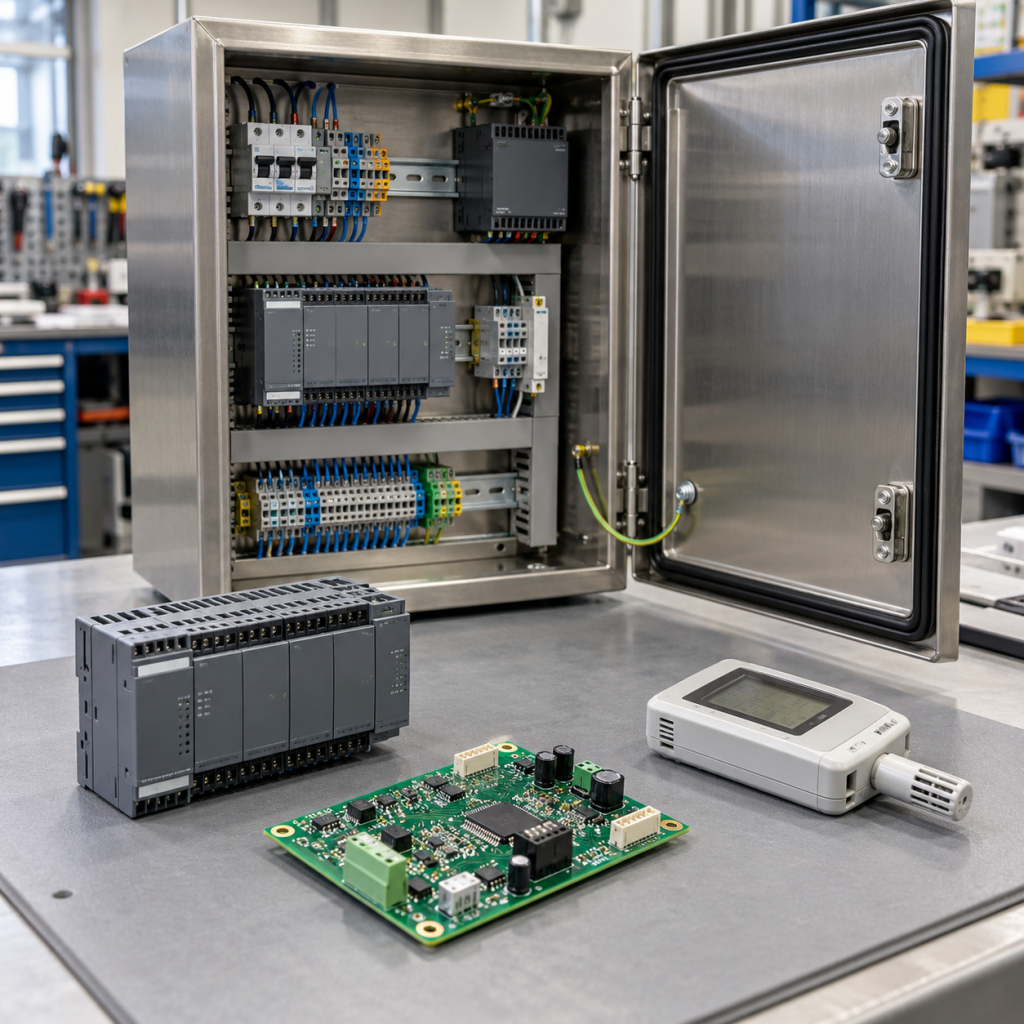
Include the cabinet location, enclosure designation, door and cable-entry condition, and any exposure to washdown, airborne contamination or outdoor weather. Keep the module’s protection specification distinct from the cabinet’s. A replacement review should establish which enclosure requirements remain necessary, not infer that a coated board can be installed anywhere.
Compare the conditions one by one
| Condition | Information needed for review |
|---|---|
| Temperature | Operating limits, mounting orientation and any stated derating. |
| Humidity | Permitted range and whether the specification excludes condensation. |
| Corrosive atmosphere | The documented environmental classification and relevant product variant. |
| Enclosure | Required cabinet protection, installation location and entry arrangement. |
| System combination | Controller, I/O, communication modules, chassis and power-supply specifications. |
Describe the actual cabinet conditions where available. Room temperature does not describe the temperature at a module inside an operating cabinet. If measured information is unavailable, mark it as unknown and provide the installation details for review rather than assigning an estimated rating.
Do not generalize a portfolio temperature range
Siemens’ SIPLUS extreme overview discusses products intended for demanding temperature, chemical and moisture conditions. Its portfolio information is useful for finding an appropriate product family, but the exact replacement still needs its own data sheet and installation conditions.
Preserve the entire order number when requesting a coated or environmentally adapted variant. A shared base design does not prove that two order codes have identical environmental specifications. Also record the revision and any relevant project approval requirement; those facts allow the reviewer to identify what must be preserved.
For a related installed part, the KNMKS Siemens 6AG1341-1CH02-7AE0 reference provides a precise identifier for an inquiry. Use the complete identifier and current manufacturer documentation when comparing a proposed alternative, including its communication function and environmental requirements.
The strongest individual module does not set the system limit
The ControlLogix 5580 and GuardLogix 5580 user manual, 1756-UM543 explains that a harsh-environment component used with lower-rated ControlLogix components is subject to the lower common specification. This is a concrete reason to compare the chassis, supply and neighboring modules as well as the replacement controller.
Identify the whole installed combination in the RFQ. Replacing one part with an extended-temperature version does not, by itself, establish a new operating limit for the station. Any proposed change to the cabinet environment or cooling arrangement should be evaluated separately from the spare-part identification.
Record the cause of replacement without assuming the cure
State whether the request follows visible corrosion, an intermittent fault, physical damage, a planned spare requirement or a change in operating conditions. Include photographs of the original labels and installation. Describe any inspection findings as observations; avoid concluding that a coating upgrade will solve the fault without a technical diagnosis.
Ask the supplier to distinguish an exact environmental variant from an alternative that changes the operating limits or enclosure requirements. Keep unresolved differences visible in the quotation, together with any engineering review needed before installation.
Prepare an inquiry that preserves the environmental requirement
Send the complete part number, module and cabinet photos, installed chassis and supply models, available environmental records, quantity and destination. The Siemens product references and industrial control systems hub can help organize the equipment context. Use the KNMKS inquiry page to include both the part identity and the conditions it must satisfy.
Where the requirement is unclear, ask for confirmation instead of shortening the description to “rugged PLC.” A clear requirement lets the reviewer compare the proposed spare against the installed application, rather than against a broad marketing label.
Questions to resolve before ordering
Does conformal coating make a module waterproof?
A coating description alone does not establish a water-ingress rating or eliminate enclosure requirements. Check the exact product and installation specifications.
Can an extended-temperature replacement raise the cabinet’s operating limit?
Not on its own. Review the full combination and its documented limits before changing the operating conditions.
Related Product Paths