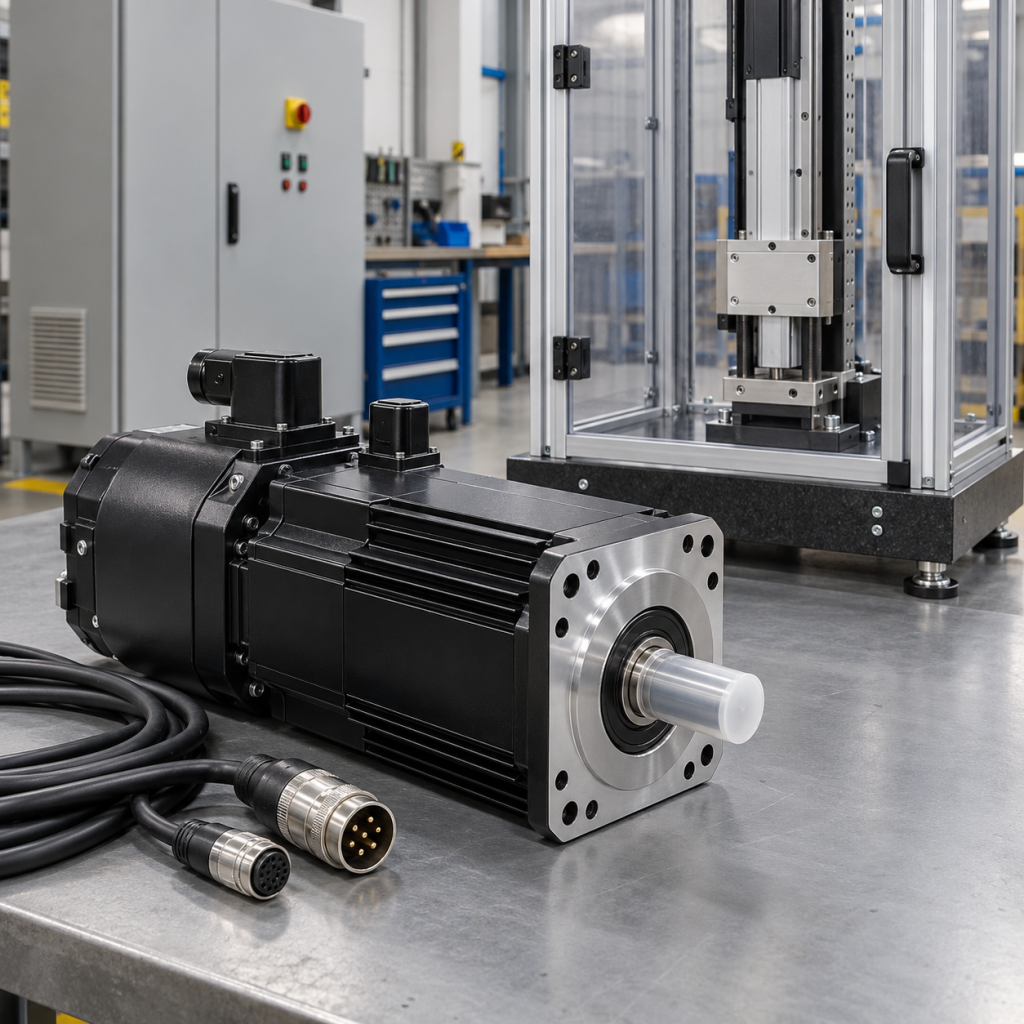
A replacement servo motor can match the flange and power rating while still leaving an important question unanswered: what holds the axis when the drive stops producing torque? On an inclined or vertical mechanism, a motor comparison needs to include the brake arrangement and the machine’s stopping concept.
Understanding servo holding brake vs STO helps buyers define the replacement scope. Safe Torque Off, a motor holding brake and a controlled stop describe different functions. Their presence in a catalog does not establish that a proposed motor-and-drive combination preserves the installed machine’s behavior.
Torque removal is not mechanical load holding
Siemens’ SINAMICS Safety Integrated overview explains that STO removes drive torque without actively braking the motion. It distinguishes that function from controlled stopping with SS1. STO therefore should not be interpreted as a mechanical device that supports a load.
For a replacement inquiry, identify what the axis must do after a stop request: decelerate, remain supported at standstill, prevent an unexpected restart, or satisfy several requirements together. Have the responsible machine engineer identify the existing safety concept rather than selecting a spare from the STO label alone.
A holding-brake option is a separate motor characteristic
In Rockwell Automation’s Vertical Load and Holding Brake Management guide, MOTION-AT003, the described Kinetix motor brakes are intended to hold a stationary shaft. The guide cautions against treating those holding brakes as safety devices or routine stopping brakes. These statements apply to the equipment discussed in that guide; the installed motor’s own documentation must define its brake capabilities.
Capture the complete motor order code, including the brake option. Do not infer that two motors have the same brake because their shafts and housings look alike. Where the existing equipment has an external brake as well as a motor brake, record both devices and their documented roles.
Compare three parts of the installed function
| Part of the function | Question for the replacement review |
|---|---|
| Stopping motion | Which drive, controller and configured sequence bring the axis to standstill? |
| Holding the load | Which brake or mechanical arrangement supports the axis after torque is removed? |
| Safety control | Which validated functions and interfaces must remain effective after the component change? |
This comparison makes the quotation requirement clearer. A request for “same motor, with brake” leaves the stopping and safety interfaces unspecified. A useful request identifies the existing components and the function each one performs.
Describe gravity and stored energy before comparing parts
State whether the motor drives a horizontal conveyor, a vertical slide, an inclined mechanism or another load. Add the axis orientation, transmission type, counterbalance arrangement and available machine drawings. The procurement team does not need to design a new braking system, but it should give the reviewer enough context to recognize that a load may move when drive torque disappears.
A Siemens application example for a vertical axis treats brake control and brake testing as parts of a defined safety design. It is an example of system-level assessment, not a universal circuit to copy into another machine. A replacement should be evaluated against the actual installation and its existing validation records.
Preserve the brake interface as well as the motor interface
Record the documented brake supply, required current, connector assignment, control device and existing brake timing settings. Include the drive model, hardware revision, firmware and any external brake-control accessory. Keep those details alongside the motor code and feedback type so the reviewer can compare the complete combination.
A brake output shown on a drive does not establish compatibility with every brake coil. Likewise, a mechanically fitting motor does not establish that its feedback and brake connections match the old assembly. Capture the original wiring and configuration before a qualified technician carries out the approved replacement procedure.
The separate KNMKS guide to servo feedback compatibility covers the encoder side of that comparison. Brake and feedback options should both be identified in the same inquiry.
Make validation part of the quoted scope
Distinguish a proposed exact spare from an alternative that changes a brake option, interface, firmware requirement or stopping sequence. Ask what remains unchanged, what needs engineering review and what acceptance evidence will be required before returning the machine to service. Do not assume that a component exchange can be approved solely from a successful unloaded motor run.
This article is for identification and quotation planning. It does not provide a procedure for releasing a brake, bypassing STO, testing a suspended load or changing a safety program. Those activities belong to the machine’s approved procedures and appropriately qualified personnel.
Send a request that includes the axis, not just the motor
Provide motor and drive nameplate photos, the full brake-option code, existing connector and wiring details, axis orientation and the reason for replacement. Add the quantity, destination and required delivery window. If the brake designation or its role is uncertain, mark that point for confirmation.
The servo systems category provides a starting point for product identification. A related ABB 3HAC037820 motor reference can be included when discussing that installed family, but a product listing is not evidence of a safety rating or a confirmed brake option. Send the exact suffix and application details through the KNMKS inquiry page for model review.
Two questions to settle before ordering
Does a drive with STO remove the need for a holding brake?
No such conclusion follows from the STO feature alone. The machine review must establish how the load is supported and how the stopping and safety functions work together.
Can a similar motor with a different brake option be treated as an exact spare?
No. Record the difference explicitly and obtain the model-specific electrical, mechanical and validation review. Similar appearance and nominal power do not resolve that difference.
Related Product Paths