
Overview
FANUC M-10iA Migration-Ready Robot Arm for Legacy M-10i Control Systems
The FANUC M-10iA is a migration-ready 6-axis industrial robot arm engineered as a direct mechanical and functional replacement for legacy M-10i series installations. With a 10 kg payload capacity and 1,422 mm maximum reach, the M-10iA maintains dimensional compatibility with existing end-of-arm tooling, fixture layouts, and floor mounting patterns used in M-10i deployments. For automation engineers managing aging production lines, the M-10iA provides a validated upgrade path that minimises program rework, reduces downtime exposure, and extends the operational life of surrounding control infrastructure.
Each unit supplied by KNMKS is pre-shipment tested, sourced from verified supply channels, and backed by a support terms confirmed by quotation covering mechanical and electrical integrity. In-stock availability supports urgent replacement requirements without extended lead times typical of discontinued or end-of-life robot models.
Migration Compatibility Table
| Parameter | Legacy M-10i | M-10iA (Replacement) | Migration Notes |
|---|---|---|---|
| Payload Capacity | 10 kg | 10 kg | No tooling re-rating required |
| Maximum Reach | 1,420 mm | 1,422 mm | Negligible delta; verify TCP offsets in program |
| Axes | 6 | 6 | Direct axis mapping; motion program compatible |
| Controller Compatibility | R-J3iC / R-J3iB | R-30iA / R-30iB | Controller upgrade may be required; verify firmware |
| Wiring / Connector | M-10i harness standard | M-10iA harness standard | Confirm dress-out routing and cable length at J1/J3 |
| Mounting Pattern | Standard FANUC floor mount | Standard FANUC floor mount | Bolt pattern compatible; verify torque spec |
| Communication Protocol | PROFIBUS / DeviceNet | EtherNet/IP / PROFINET | Protocol migration required if upgrading controller |
| Installation Space | Existing cell envelope | Identical footprint | No cell re-layout required in standard configurations |
| Firmware Version | R-J3iC legacy | R-30iA V7.x or later | Confirm version before loading backed-up TP programs |
| Support terms | End-of-life / expired | support terms confirmed by quotation | Covered from date of shipment by KNMKS |
Retrofit Planning for Existing Automation Systems
A successful M-10iA retrofit begins well before the robot is physically swapped. Engineers should first audit the existing R-J3iC or R-J3iB controller to determine whether it can be retained or must be replaced with an R-30iA or R-30iB unit. If the controller is being upgraded simultaneously, the A05B-2500 series controller cabinet should be evaluated for available rack space, since additional I/O expansion modules — such as the A03B-0819 series distributed I/O units — may need to be relocated or re-addressed within the new backplane layout.
Power supply capacity is a critical checkpoint. The existing 24 VDC control power rail must be verified against the M-10iA’s servo amplifier draw, particularly when the A06B-6096 series servo amplifier modules are being carried over from the legacy system. Any shortfall in supply headroom should be resolved before commissioning to avoid nuisance trips during high-acceleration moves.
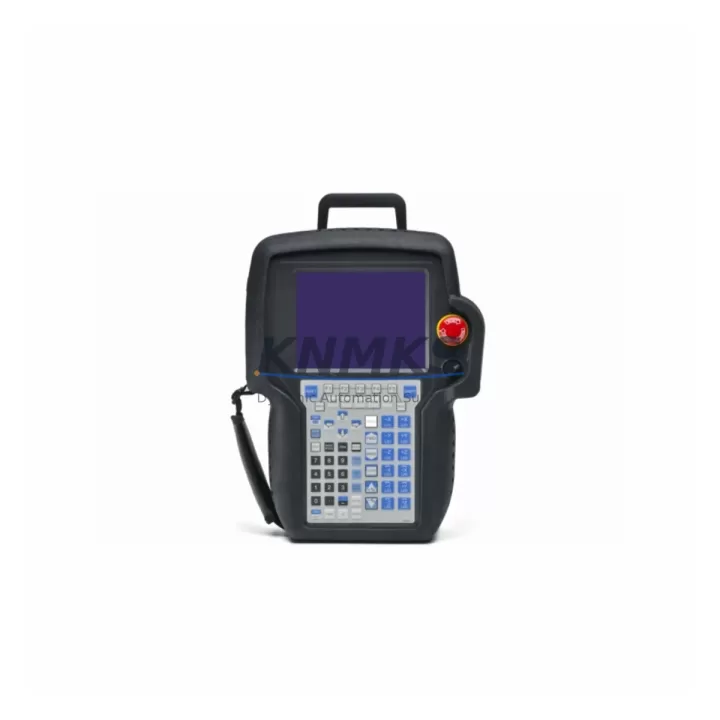
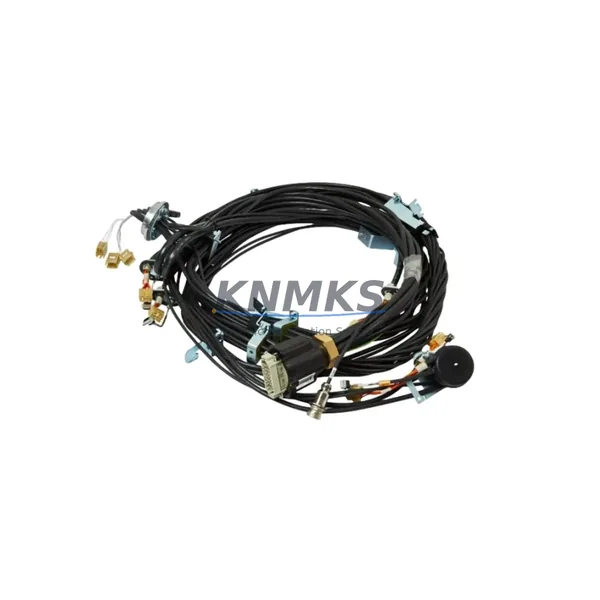
Terminal wiring at the robot base requires careful documentation prior to disconnection. The M-10iA uses a standardised FANUC connector layout at J1, but dress-out routing for the teach pendant cable and the A660-2005 series robot cable assembly should be confirmed against the new arm’s cable management brackets. Where fieldbus communication was previously handled via PROFIBUS using a FANUC PROFIBUS board, migration to EtherNet/IP or PROFINET — supported natively on R-30iA controllers — will require updating the PLC-side network configuration and re-mapping I/O addresses in the host SCADA or DCS layer.
HMI screens referencing robot status signals should be reviewed for tag name changes introduced by the controller upgrade. If the facility uses a FANUC iHMI or a third-party operator panel connected via the controller’s CRMA15/CRMA16 I/O interface, signal assignments must be validated against the new I/O module addressing scheme before live operation. Programming cables such as the A05B-2518-J001 USB programming cable remain compatible with R-30iA systems and can be used to load, verify, and back up TP and KAREL programs during the transition.
For installations where the M-10i was integrated with a vision system using the FANUC iRVision platform, camera calibration data and vision program references stored in the legacy controller must be exported and re-imported into the replacement R-30iA. Grid calibration should be re-run in the new cell configuration to account for any minor positional variance introduced during mechanical reinstallation.
Downtime Control During System Migration
Minimising production downtime during an M-10iA swap requires a structured pre-migration preparation phase. All existing TP programs, system variables, I/O configurations, and mastering data should be backed up from the legacy controller to a secure offline location before any mechanical work begins. FANUC’s controller backup utility supports full image backup to a USB memory device, preserving program logic, coordinate frames, and tool data that would otherwise require manual re-entry.
Where production schedules permit only a narrow maintenance window, a parallel commissioning approach is recommended: the replacement M-10iA and its associated R-30iA controller should be pre-configured, pre-wired, and dry-run tested on a bench or in a staging area before the cutover shift. This allows mastering, zero-point calibration, and initial program verification to be completed offline, reducing the live cutover to a mechanical swap, cable reconnection, and final TCP verification — typically achievable within a single planned shutdown window.
Field engineers should confirm that the robot’s J1 through J6 mastering positions are re-established using the FANUC mastering fixture or witness marks transferred from the legacy arm. Incorrect mastering is the most common cause of extended post-swap commissioning time and should be treated as a critical path item. Once mastering is confirmed, a slow-speed dry run of the full production cycle — with personnel clear of the work envelope — should be completed before returning the cell to automatic mode.
Retaining the original program logic without modification is achievable in most M-10i to M-10iA migrations where the controller generation is also updated, provided that coordinate frame data is accurately transferred and I/O address mapping is preserved. Any changes to motion parameters, zone definitions, or speed overrides should be documented and reviewed by the responsible automation engineer before sign-off.
Retrofit Support FAQ
Q1: Is the FANUC M-10iA a direct drop-in replacement for the M-10i without controller changes?
The M-10iA is mechanically compatible with M-10i installations in terms of payload, reach, and mounting pattern. However, the M-10iA is designed to operate with R-30iA or R-30iB generation controllers. If the existing installation uses an R-J3iC or R-J3iB controller, a controller upgrade is strongly recommended to ensure full firmware and communication compatibility. KNMKS can advise on compatible controller options available from stock.
Q2: What pre-shipment testing is performed on the M-10iA before delivery?
Each FANUC M-10iA unit supplied by KNMKS undergoes pre-shipment functional testing covering axis movement across the full range of motion, servo drive response, brake function verification, and connector integrity checks. Units are inspected for mechanical condition and packed to IEC transport standards. A test report is available upon request for quality-critical procurement processes.
Q3: How should I handle wiring differences between the M-10i and M-10iA during retrofit?
The M-10iA uses the standard FANUC robot cable interface at the J1 base. In most cases, the existing A660-2005 series robot cable assembly can be reused if it is in serviceable condition and of sufficient length for the new arm’s dress-out routing. Terminal assignments at the controller end remain consistent across R-30iA installations. A wiring audit comparing the legacy harness pinout against the M-10iA interface drawing is recommended before reconnection.
Q4: What is the support terms coverage and what does it include?
The FANUC M-10iA supplied by KNMKS is covered by a support terms confirmed by quotation from the date of shipment. Support terms coverage includes mechanical defects, servo motor faults, and electrical integrity failures under normal operating conditions. Support requests are supported directly by KNMKS. Units confirmed defective within the confirmed support period are eligible for replacement or repair. Contact admin@knmks.com for support terms registration and claim procedures.
© 2026 KNMKS. All rights reserved.
Original Source: https://knmks.com
Contact: admin@knmks.com | +86 18359268345
Product Identification
- Brand / Ecosystem
-
FANUC
Assorted Brands - Model / Series
-
M-10iA
Assorted Series - Product Family
- Other Components
- Availability Status
- Available on request after model and quantity confirmation
- Inquiry Type
- B2B RFQ, replacement inquiry and project spare-part request
- Pre-Quote Check
- Exact SKU, brand, series, quantity, nameplate photos and destination country are checked before quotation
System Path
Where this product fits in the KNMKS automation structure.
Specification & Inquiry Focus
- Component range
- Breakers, terminals and cabinet accessories
- Common needs
- Model, photo and installation requirement
- Project support
- Maintenance and mixed spare-part inquiry
Buyer Confirmation
Information KNMKS checks before replying.
- Exact model
- M-10iA
- Brand / ecosystem
- FANUC
- Product family
- Other Components
- Application note
- Replacement, maintenance, project build or spare-part list
- Useful photos
- Nameplate, installed unit, cabinet layout or connector side
- Delivery details
- Quantity, destination country and target schedule
Document Support
Files and notes can be confirmed during quotation.
- Product photos or nameplate confirmation when available
- Packing and delivery notes before quotation confirmation
- Support scope and delivery terms confirmed per inquiry
- Export document coordination for qualified B2B requests
Inquiry Support
- Mixed automation spare parts inquiry
- Cabinet component and accessory support
- Model identification from photos or labels
What to Send Us
- Brand and exact model number: FANUC M-10iA
- Quantity and required delivery time
- Application, replacement requirement or nameplate photo
- Destination country and shipping preference
RFQ Preparation
This is a product inquiry page built for RFQ communication.
Fast Model Check
Send this model to KNMKS for confirmation.
Include quantity, destination country and photos if this is a maintenance replacement. The inquiry will be saved with a reference number after submission.
Brand & Compatibility Note
KNMKS displays automation product information for well-known industrial brand ecosystems and compatible replacement references. Brand names are used for product identification and compatibility reference only; final availability and commercial terms are confirmed per quotation.
 Manufacturing
 Machine Tools
 Packaging
 Energy & Power
 PLCs & Controllers
 HMI & Displays
 Servo Systems
 Variable Frequency Drives