
Overview
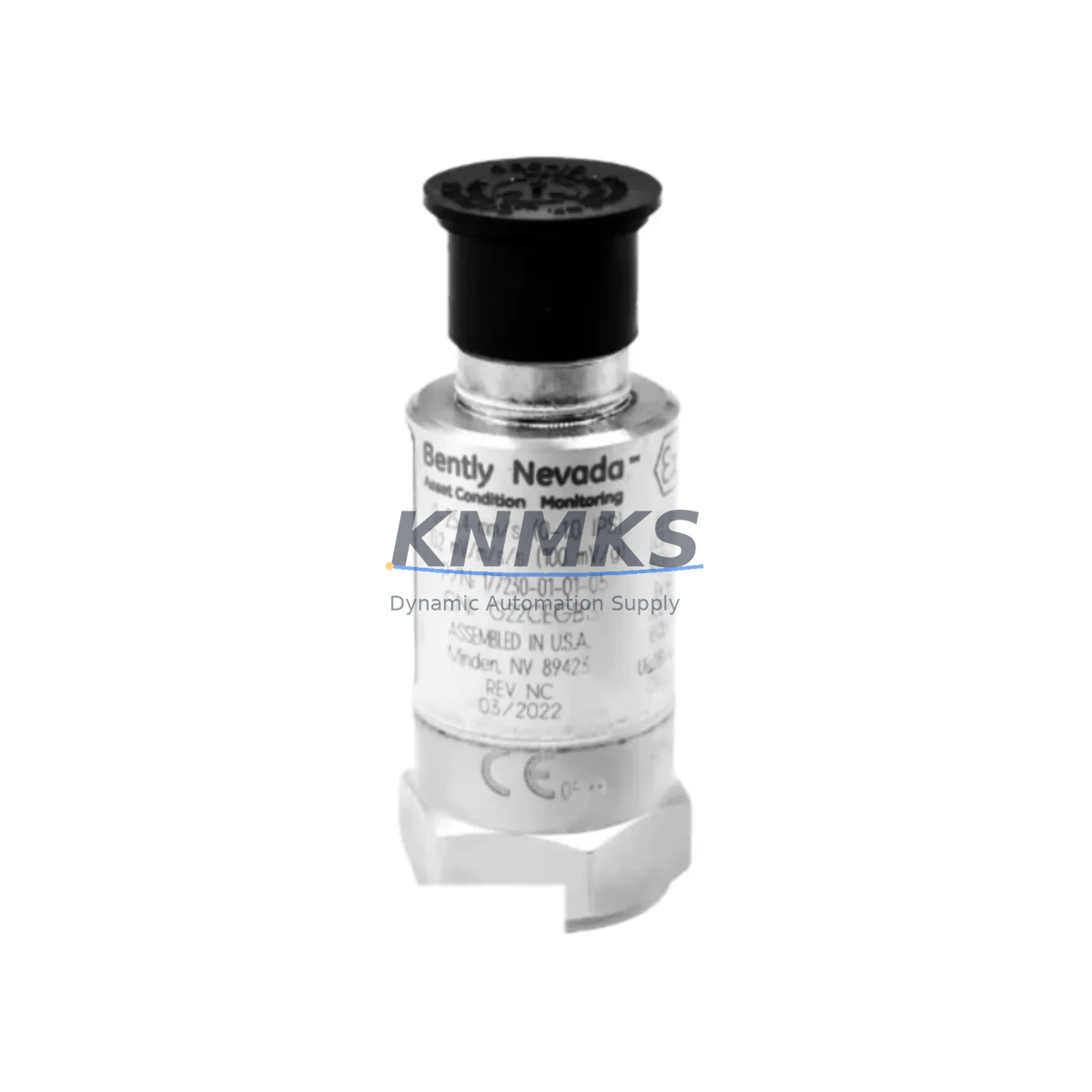
Bently Nevada TP100 Migration-Ready Accelerometer for Legacy Control Systems
The Bently Nevada TP100 is a precision industrial accelerometer engineered for seamless integration into legacy vibration monitoring and machinery protection systems built on the Bently Nevada TP Series platform. As aging TP Series installations approach end-of-support milestones, plant engineers and reliability teams face mounting pressure to source verified replacement components that preserve existing wiring infrastructure, signal conditioning chains, and System 1 software configurations without triggering a full-platform overhaul. The TP100 addresses this challenge directly, offering a migration-ready solution that minimizes engineering rework and keeps critical rotating machinery online.
Designed as a direct retrofit for discontinued TP Series accelerometer models, the TP100 maintains the same 4-pin MIL-spec connector footprint and IEPE (Integrated Electronics Piezo-Electric) signal output standard, allowing field technicians to swap the sensor without modifying terminal blocks, cable runs, or the Bently Nevada 3500/40M proximitor and velocity monitor rack cards that process the incoming signal. Before installation, engineers should confirm the bias voltage supply range at the monitor input — typically 18–24 VDC for IEPE circuits — and verify that the existing coaxial cable or armored extension cable meets the capacitance-per-foot specification to avoid signal attenuation over long cable runs to the 3500 Series rack.
When integrating the TP100 into a 3500 Series machinery protection rack, technicians should review the channel configuration in the 3500 Rack Configuration Software to ensure the transducer type is set to accelerometer mode and that the full-scale range, integration filter, and alarm setpoints are carried over from the previous sensor’s calibration record. If the legacy installation used a Bently Nevada 330500 or 330525 proximitor cable assembly as part of a hybrid proximity-acceleration measurement scheme, the TP100’s mounting orientation and sensitivity axis must be re-confirmed against the original machine train drawing to maintain consistent vibration vector data in System 1 condition monitoring software.
For plants running older Bently Nevada 7200 Series or 3300 Series monitoring hardware alongside newer 3500 Series racks in a mixed-generation control cabinet, the TP100 can serve as a standardized accelerometer across both platforms, simplifying spare parts inventory and reducing the number of unique sensor SKUs that maintenance teams must stock. This is particularly valuable during phased migration projects where sections of the plant are upgraded incrementally while legacy racks remain in service.
Communication protocol continuity is another critical consideration during TP Series retrofit projects. The TP100 outputs a standard IEPE analog signal, which is compatible with the 4–20 mA transmitter modules and Modbus RTU gateway cards commonly used to bridge Bently Nevada rack data into DCS or SCADA platforms such as Emerson DeltaV or Honeywell Experion. If the site uses a Bently Nevada TDXnet or System 1 Evolution data acquisition node, the TP100’s sensitivity specification (typically 100 mV/g) should be entered into the node’s channel configuration to ensure accurate engineering unit conversion before alarm thresholds are re-validated.
Installation space is rarely a constraint with the TP100, as its compact cylindrical housing is dimensionally equivalent to the legacy TP Series sensors it replaces. However, technicians should inspect the mounting pad surface for corrosion or thread damage before installation, and apply the correct torque specification to the mounting stud to avoid resonance errors at high-frequency measurement points. Where the original sensor used an adhesive mounting base, a stud-mount adapter compatible with the TP100’s M6 or 1/4-28 UNF thread should be sourced to maintain measurement integrity.
Firmware compatibility is not a concern for the TP100 itself, as it is a passive IEPE transducer with no embedded firmware. However, the monitor cards and rack controllers that process its output — including the 3500/40M, 3500/42M, and 3500/45 modules — should be running current firmware revisions to ensure proper handling of the TP100’s frequency response curve, particularly for high-speed machinery operating above 10,000 RPM where roll-off characteristics become significant.
Every TP100 unit shipped by KNMKS undergoes pre-shipment functional testing, including sensitivity verification against a calibrated reference accelerometer, insulation resistance check, and connector integrity inspection. Units are supplied with a calibration certificate traceable to national standards, supporting ISO 17025-aligned maintenance documentation requirements. Stock is maintained for immediate dispatch, with typical lead times of 1–3 business days for standard orders.
Migration Compatibility Table
| Parameter | Legacy TP Series Sensor | Bently Nevada TP100 | Retrofit Notes |
|---|---|---|---|
| Output Signal | IEPE / Voltage | IEPE (100 mV/g) | Direct signal-compatible; no transmitter change required |
| Connector Type | MIL-spec 4-pin | MIL-spec 4-pin | Drop-in connector fit; existing cable assemblies retained |
| Mounting Thread | M6 / 1/4-28 UNF | M6 / 1/4-28 UNF | Confirm mounting pad thread condition before installation |
| Supply Voltage | 18–24 VDC (IEPE bias) | 18–28 VDC | Compatible with 3500/40M and 3500/42M monitor cards |
| Frequency Range | 2–10,000 Hz (typical) | 0.5–15,000 Hz (±3 dB) | Extended range; update monitor filter settings if needed |
| Communication | Analog IEPE → Modbus/DCS | Analog IEPE → Modbus/DCS | No protocol migration required; gateway cards unchanged |
| Monitor Compatibility | 3500/40M, 3300, 7200 Series | 3500/40M, 3500/42M, 3500/45 | Verify channel config in 3500 Rack Configuration Software |
| Firmware Dependency | None (passive transducer) | None (passive transducer) | Monitor card firmware update recommended for high-RPM apps |
| Calibration | Factory certificate | Traceable calibration cert included | Supports ISO 17025 maintenance documentation |
| Support terms | Varies (legacy/EOL) | support terms confirmed by quotation | Covered by KNMKS 12-month replacement support terms |
Retrofit Planning for Existing Automation Systems
A successful TP100 retrofit begins well before the sensor arrives on site. The engineering team should pull the original machine train instrumentation drawing to confirm the number of measurement planes, sensor orientation (radial vs. axial), and the cable routing path from the machine bearing housing to the junction box and on to the 3500 Series rack. If the existing coaxial extension cable — often a Bently Nevada 330130 or 330180 series armored cable — shows signs of insulation degradation or connector corrosion, it should be replaced concurrently with the sensor to avoid introducing a new noise floor into the vibration signal chain.
Within the control cabinet, the 3500 Series rack’s power supply module should be inspected to confirm it can support the additional current draw if multiple sensors are being replaced simultaneously. The 3500/15 power supply module, for example, has defined current budgets per rack slot, and adding higher-sensitivity accelerometers across multiple channels may require a power budget review. Similarly, if the retrofit scope includes replacing proximity probes alongside the TP100 accelerometers — for example, substituting discontinued 3300 XL 8mm probes with current-generation 3300 XL 11mm probes — the combined wiring changes should be mapped against the terminal block layout in the I/O marshalling panel to prevent cross-wiring errors during reconnection.
For plants that use a Bently Nevada 3500/92 communication gateway or a TDXnet data acquisition module to feed vibration data into a plant historian or DCS, the TP100 channel sensitivity value must be updated in the gateway’s tag database to reflect the new sensor’s output. Failure to update this value will result in incorrect engineering unit scaling in the DCS trend displays and historian archives, which can mask genuine changes in machinery vibration amplitude during the post-retrofit monitoring period.
If the retrofit is part of a broader control system migration — for example, transitioning from a legacy Bently Nevada 3300 Series rack to a 3500 Series rack while simultaneously upgrading the DCS from an older Honeywell TDC 3000 to Experion PKS — the TP100 installation should be sequenced after the new rack is powered and channel-configured but before the DCS cutover, allowing the vibration monitoring system to be independently validated against baseline machinery data before the process control layer is switched over.
Downtime Control During System Migration
Minimizing unplanned downtime during a TP Series accelerometer replacement requires a structured pre-outage preparation protocol. Before the maintenance window opens, technicians should have the TP100 unit, calibration certificate, replacement cable assembly (if required), mounting stud torque specification, and the 3500 Rack Configuration Software laptop pre-staged at the work site. The existing sensor’s alarm bypass should be activated in the 3500 rack — using the rack’s front-panel bypass switch or the software bypass function — before disconnecting the legacy sensor, to prevent spurious vibration alarms from triggering a process shutdown during the swap.
Once the TP100 is installed and the cable reconnected, the monitor channel should be brought out of bypass incrementally: first confirming that the bias voltage at the monitor input is within the expected range (typically 10–12 VDC for a properly functioning IEPE circuit), then verifying that the broadband vibration reading is within the expected baseline range for the machine at its current operating condition. If the machine is running during the sensor swap (hot swap on a non-critical measurement point), the vibration trend should be observed for at least 15 minutes post-installation to confirm signal stability before the bypass is removed and alarms are re-enabled.
For critical machinery where any measurement gap is unacceptable, a temporary portable data collector — such as a CSI 2140 or equivalent — can be used to maintain continuous vibration monitoring on the bearing housing during the brief period when the permanent sensor is disconnected. This approach preserves the condition monitoring record continuity required by many reliability-centered maintenance programs and satisfies insurance or regulatory requirements for continuous protection of high-value rotating assets.
Post-installation, the TP100’s first 24-hour vibration trend should be archived as the new baseline reference in System 1 or the plant historian, replacing the legacy sensor’s baseline data. Alarm setpoints should be reviewed and adjusted if the TP100’s extended frequency range reveals previously unmeasured high-frequency content that was attenuated by the legacy sensor’s narrower bandwidth. All retrofit activities, including the sensor serial number, calibration certificate number, installation torque, and post-installation bias voltage reading, should be recorded in the plant’s maintenance management system to support future audits and support requests.
Retrofit Support FAQ
Q: Is the Bently Nevada TP100 a direct replacement for all legacy TP Series accelerometers?
A: The TP100 is compatible with the majority of TP Series accelerometer applications, sharing the same IEPE output standard, MIL-spec connector, and mounting thread dimensions. For applications involving specialized high-temperature variants or intrinsically safe (ATEX/IECEx) certified sensors, please contact KNMKS at admin@knmks.com to confirm the appropriate replacement model before ordering.
Q: What commissioning steps are required after installing the TP100?
A: After physical installation, verify the IEPE bias voltage at the monitor input (10–12 VDC expected), confirm the sensitivity value is correctly entered in the 3500 Rack Configuration Software or TDXnet tag database, remove the alarm bypass, and observe the vibration trend for a minimum of 15 minutes to confirm signal stability. Archive the initial reading as the new baseline in System 1 or your plant historian.
Q: Does KNMKS provide pre-shipment testing for the TP100?
A: Yes. Every TP100 unit undergoes sensitivity verification against a calibrated reference accelerometer, insulation resistance testing, and connector integrity inspection before dispatch. A traceable calibration certificate is included with each unit. Standard lead time is 1–3 business days from confirmed order.
Q: What support terms coverage applies to the TP100?
A: All TP100 units supplied by KNMKS are covered by a 12-month replacement support terms from the date of shipment, covering manufacturing defects and premature failure under normal operating conditions. Support requests are processed via admin@knmks.com with reference to the unit serial number and original order documentation.
© 2026 KNMKS. All rights reserved.
Original Source: https://knmks.com
Contact: admin@knmks.com | +86 18359268345
Product Identification
- Brand / Ecosystem
-
Bently Nevada
Bently Nevada - Model / Series
-
TP100
Legacy Series - Product Family
- Sensors
- Availability Status
- Available on request after model and quantity confirmation
- Inquiry Type
- B2B RFQ, replacement inquiry and project spare-part request
- Pre-Quote Check
- Exact SKU, brand, series, quantity, nameplate photos and destination country are checked before quotation
System Path
Where this product fits in the KNMKS automation structure.
Specification & Inquiry Focus
- Sensor range
- Photoelectric, proximity and process sensors
- Common needs
- Output type, distance and connector
- Project support
- Machine detection and replacement inquiry
Buyer Confirmation
Information KNMKS checks before replying.
- Exact model
- TP100
- Brand / ecosystem
- Bently Nevada
- Product family
- Sensors
- Application note
- Replacement, maintenance, project build or spare-part list
- Useful photos
- Nameplate, installed unit, cabinet layout or connector side
- Delivery details
- Quantity, destination country and target schedule
Document Support
Files and notes can be confirmed during quotation.
- Product photos or nameplate confirmation when available
- Packing and delivery notes before quotation confirmation
- Support scope and delivery terms confirmed per inquiry
- Export document coordination for qualified B2B requests
Inquiry Support
- NPN/PNP, analog and digital output checking
- Connector and cable compatibility review
- Fast inquiry support for maintenance teams
What to Send Us
- Brand and exact model number: Bently Nevada TP100
- Quantity and required delivery time
- Application, replacement requirement or nameplate photo
- Destination country and shipping preference
RFQ Preparation
This is a product inquiry page built for RFQ communication.
Fast Model Check
Send this model to KNMKS for confirmation.
Include quantity, destination country and photos if this is a maintenance replacement. The inquiry will be saved with a reference number after submission.
Brand & Compatibility Note
KNMKS displays automation product information for well-known industrial brand ecosystems and compatible replacement references. Brand names are used for product identification and compatibility reference only; final availability and commercial terms are confirmed per quotation.
 Manufacturing
 Machine Tools
 Packaging
 Energy & Power
 PLCs & Controllers
 HMI & Displays
 Servo Systems
 Variable Frequency Drives